


How to Choose an Aluminum Baffle Ceiling Supplier: A Verifiable Buyer’s Checklist
To select a reliable aluminum baffle ceiling supplier, verify that they hold ISO 9001, CE, and SGS certifications; request third-party test reports for fire, wind, and acoustic performance; confirm they can produce shop drawings and CNC-fabricated samples; audit their export packing and container-loading procedures; and ensure after-sales documentation and technical support are contractually guaranteed before committing.
1. Certifications to Request Before Signing
Certifications are the first filter. A supplier that can present valid third-party credentials has already passed external quality and compliance audits. When evaluating an aluminum baffle ceiling supplier, ask to see the following:
- ISO 9001 — confirms a documented quality management system is in place across design, production, and inspection.
- CE — required for European market access; demonstrates compliance with relevant product standards.
- SGS — independent verification of material composition, coating thickness, and performance claims.
Do not accept a supplier’s self-declaration alone. Request the actual certificate numbers and verify them against the issuing body’s online registry. If a supplier cannot produce these documents on request, treat it as a red flag regardless of how competitive their pricing appears.
What to Do If a Supplier Lacks Full Certification
Some suppliers may hold partial certification — for example, ISO 9001 but not CE. In such cases, determine whether your project jurisdiction requires CE marking. If it does, a supplier without CE certification will not meet your compliance obligations, and you should move to the next candidate.
2. Third-Party Test Reports: Fire, Acoustic, and Structural Performance
Certifications cover process quality; test reports cover product performance. For aluminum baffle ceilings, the critical reports to request are:
| Test Category | Why It Matters | What to Verify |
|---|---|---|
| Fire performance | Building codes require specific fire ratings for ceiling systems in commercial and public buildings | Report from an accredited laboratory; compliance with your jurisdiction’s fire code requirements |
| Acoustic performance (NRC) | Baffle ceilings are often specified for noise control in airports, hospitals, and open-plan offices | Measured NRC value; test method standard referenced (e.g., ASTM C423 or EN ISO 354) |
| Wind load / structural | Relevant for exterior baffle installations or high-ceiling interior applications | Load test results; deflection limits; attachment method validation |
| Coating adhesion and corrosion | Powder coating, PVDF, and anodized finishes must resist environmental degradation | Salt-spray test hours; cross-cut adhesion results; gloss retention data |
Fire Compliance: What Buyers Must Understand
Fire rating requirements vary by jurisdiction and building type. A supplier may claim a certain fire performance level, but you must confirm that claim against a third-party test report that matches the standard your local authority having jurisdiction (AHJ) accepts. Never rely on a verbal assertion. For aluminum baffle ceiling systems, the fire rating must be verified by a third-party report specific to the exact product configuration — substrate alloy, coating system, and backing material — that you intend to install. If the supplier’s report covers a different configuration, it may not be accepted by your building inspector.
3. Shop Drawing and CNC Fabrication Capability
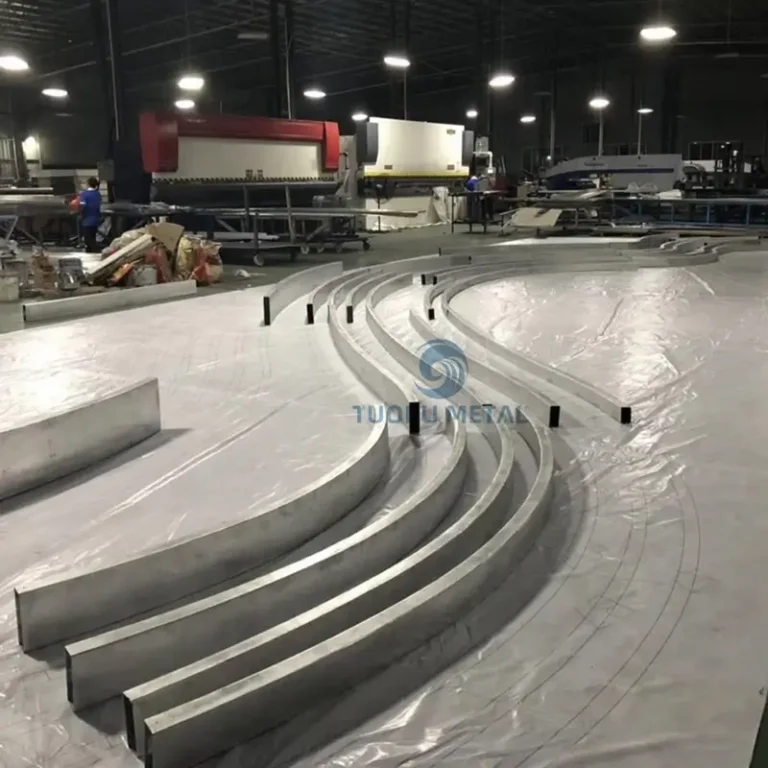
Aluminum baffle ceilings are rarely off-the-shelf products. Each project requires custom spacing, depth, profile, and finish. A competent supplier must demonstrate both engineering and fabrication capability:
- Shop drawing production — the supplier should generate detailed fabrication drawings from your architect’s specifications, including baffle dimensions, suspension layout, joint details, and opening coordinates for MEP penetrations.
- CNC-controlled cutting and forming — precision CNC equipment ensures consistent baffle profiles, accurate perforation patterns, and repeatable quality across large orders.
- Sample policy — before committing to a full order, request a physical sample or prototype. This allows you to verify finish quality, edge treatment, and the accuracy of the suspension system.
Ask the supplier to show you their shop drawing workflow and CNC equipment photos or videos. A supplier that cannot demonstrate these capabilities is likely sub-contracting critical steps, which introduces quality risk and reduces your visibility into the production process.
4. Export Packing and Container Loading Standards
Aluminum baffle ceilings are long, slender components that are vulnerable to bending and surface damage during international shipping. Evaluate the supplier’s packing and loading procedures against these criteria:
| Check Item | Acceptable Standard |
|---|---|
| Individual baffle wrapping | EPE foam or corrugated paper between each piece; no bare metal-to-metal contact |
| Bundle securing | Strapped with protective edge guards; bundle weight within handling limits |
| Container loading plan | Supplier provides a loading diagram showing how baffle lengths are arranged to maximize container volume while preventing deformation |
| Moisture protection | Desiccant bags and vapor-barrier wrapping inside the container |
| Packing list and labeling | Each bundle labeled with project name, baffle type, length, and quantity for easy on-site identification |
Request photos of previous container load-outs for similar baffle ceiling projects. A supplier that proactively shares this evidence understands international logistics and takes damage prevention seriously.
5. After-Sales Documentation and Technical Support
The procurement relationship does not end at shipment. For aluminum baffle ceiling installations, the following after-sales documentation should be included in your contract:
- Installation manual — step-by-step guidance for suspension system assembly, baffle alignment, and finishing trim installation.
- As-built drawing template — a document the installer completes on site to record actual dimensions and any field modifications.
- Maintenance guidelines — cleaning procedures and recommended intervals for the specified coating system.
- Technical contact — a named engineer or project manager available for installation queries, particularly for complex geometries or unusual suspension configurations.
Verify that spare parts or replacement baffle panels can be ordered after project completion. Supply chain continuity for a specific finish or profile is not guaranteed indefinitely, so securing a spare quantity at the time of purchase is prudent.
Frequently Asked Questions
What certifications should an aluminum baffle ceiling supplier hold?
Look for ISO 9001 for quality management, CE for European market compliance, and SGS for independent product verification. Request copies of all certificates and verify them against the issuing body’s registry before proceeding.
How do I verify a supplier’s fire performance claims?
Ask for a third-party test report from an accredited laboratory that covers the exact product configuration you plan to install. Fire rating requirements vary by jurisdiction, so confirm that the test standard referenced in the report is accepted by your local building authority. Do not accept verbal claims without documented evidence.
Should I request a sample before placing a large order?
Yes. A physical sample allows you to verify coating finish, edge quality, baffle profile accuracy, and the suspension system’s fit and finish. Reputable suppliers typically provide samples for evaluation, sometimes at a nominal cost that is credited against the full order.
What should I check about a supplier’s export packing and container loading?
Confirm that individual baffles are wrapped with protective material, bundles are secured with edge guards, the container loading plan maximizes volume while preventing deformation, and moisture protection measures are in place. Request photos of previous container load-outs for similar products.
What after-sales documentation should be included in the contract?
The contract should specify an installation manual, an as-built drawing template, maintenance guidelines for the selected coating system, and a named technical contact for installation support. Also confirm the availability of spare or replacement panels after project completion.
For project-specific questions about aluminum baffle ceiling sourcing, certification verification, or technical requirements, contact TOP METAL & TUORUNDA. Reach Jimmy on WhatsApp at +86-139-2919-8578 or via email at sales2@trdoutdoor.com.
Talk to Our Team
Planning a project or comparing suppliers? Send us your drawings, panel schedule or quantity list and we will come back with a specification proposal and a budget range for your review.
- Company: TOP METAL & TUORUNDA
- Contact: Jimmy
- WhatsApp: +86-139-2919-8578
- Email: sales2@trdoutdoor.com