

Direct Answer
Perforated aluminum panels for school buildings are specified by selecting the appropriate alloy (typically 6063-T5 or 6063-T6), determining perforation pattern and open area ratio, choosing a surface finish suitable for high-traffic environments, and verifying that acoustic and fire performance meet local code requirements. FstopMetal manufactures AP300 perforated panels in Foshan, China, with customizable hole patterns and radii, and offers powder coating, anodizing, and PVDF finishes.
Why Perforated Aluminum Panels Are a Strong Choice for Schools
School buildings demand materials that balance durability, safety, acoustics, and aesthetics. Perforated aluminum panels address all four requirements in a single product category.
Acoustic Performance in Learning Spaces
Noise control is one of the most critical factors in school design. Studies consistently show that excessive ambient noise impairs speech intelligibility and student comprehension. Perforated aluminum panels, when paired with an acoustic backing such as foam or mineral wool, can achieve Noise Reduction Coefficient (NRC) ratings of 0.85 and above. This makes them suitable for:
- Classroom ceiling installations where speech clarity is paramount
- Corridor and lobby walls that act as sound buffers between high-traffic zones
- Auditoriums and multipurpose halls requiring controlled reverberation
Durability in High-Traffic Environments
Schools are among the most demanding environments for interior and exterior cladding. Students, staff, and equipment create constant wear on surfaces. Aluminum panels resist denting, scratching, and corrosion far better than many alternative materials. The 6063 alloy series provides excellent structural rigidity while remaining lightweight enough for easy handling and installation on both ceiling grids and wall substrates.
Design Flexibility
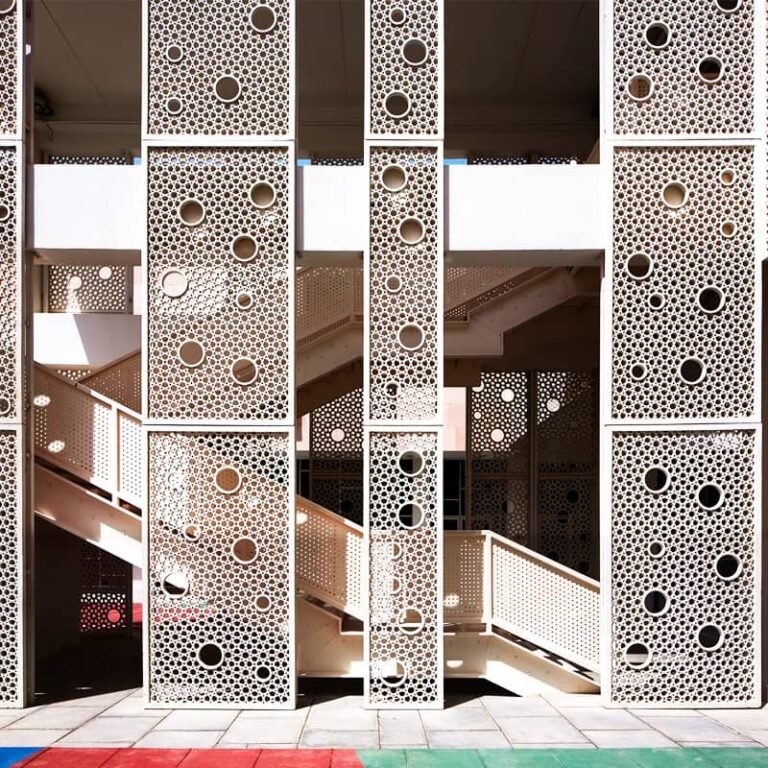
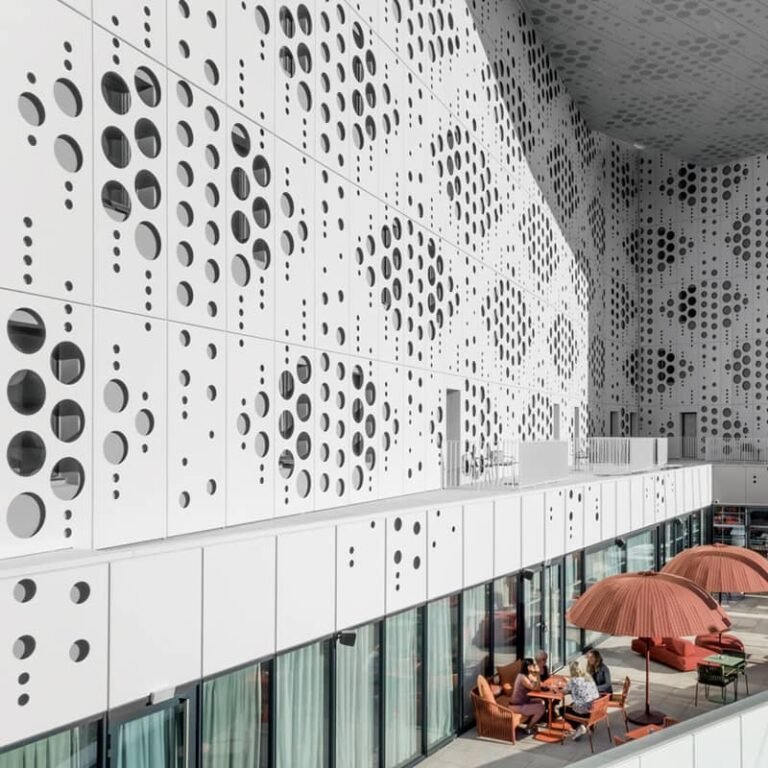
Perforated panels enable parametric facade and interior design. The AP300 series from FstopMetal supports variable open-area ratios and custom hole patterns, allowing architects to create visual identity while maintaining ventilation where needed. For curved applications, the AP200 series offers radius customization, opening up possibilities for rounded corners, arched entryways, and sculptural ceiling features.
Key Specification Parameters
When specifying perforated aluminum panels for a school project, the following parameters must be defined in the contract documents:
Material and Temper
The standard material for architectural applications is 6063 aluminum alloy. For projects requiring higher structural strength, 6063-T5 or 6063-T6 temper options are available. The T6 temper provides greater yield strength, which is relevant for larger span ceiling installations or exterior facades subject to wind load.
Perforation Design
The perforation pattern determines both the aesthetic character and the functional performance of the panel. Key variables include:
- Hole shape: round, square, slot, or custom geometric patterns
- Open area percentage: typically ranges from 5% to 60%, depending on ventilation and acoustic requirements
- Panel thickness: common gauges range from 2 mm to 4 mm for interior applications and 4 mm to 6 mm for exterior facades
Surface Finish Selection
The finish choice affects both appearance and long-term maintenance. The following finishes are commonly specified for school projects:
| Finish Type | Typical Thickness | Best Suited For | Maintenance Profile |
|---|---|---|---|
| Powder Coating | 60–80 microns | Interior ceilings, classroom walls | Low — washable, color-stable |
| Anodizing | 15–25 microns | High-traffic corridors, entrances | Low — inherently corrosion-resistant |
| PVDF (Kynar 500) | 25–30 microns | Exterior facades, sun-exposed areas | Very low — superior UV resistance |
| Wood Grain Transfer | Standard | Warm aesthetic applications | Low — comparable to powder coat |
Acoustic Configuration
For ceiling applications where NRC performance is a specification requirement, the panel must be specified with an acoustic backing system. Options include:
- Perforated panel with open face only — decorative and ventilated, minimal acoustic absorption
- Perforated panel with foam backing — moderate NRC improvement, suitable for general spaces
- Perforated panel with mineral wool backing — highest NRC performance, recommended for classrooms and libraries
Fire Compliance and Code Requirements
Fire safety in schools is governed by strict building codes that vary by jurisdiction. Architects must understand the following before specifying perforated aluminum panels:
Understanding Fire Rating Requirements
Fire rating requirements vary by jurisdiction and by the specific building code edition adopted. In the United States, the International Building Code (IBC) and NFPA standards apply. In Europe, EN 13501-1 classification is the reference. The aluminum substrate itself is non-combustible, but the overall fire performance of a panel assembly — including any backing material, adhesives, and mounting hardware — must be evaluated as a system.
Verification Through Testing
Fire rating claims must be verified by a third-party report. When specifying panels for a school project, the architect should request:
- Test reports from an accredited laboratory (e.g., SGS or equivalent)
- Assembly-level fire performance data, not just substrate data
- Confirmation that the specified finish system does not compromise the fire rating
Never assume a fire rating class applies without documented test evidence. The approval workflow typically involves submitting test reports to the Authority Having Jurisdiction (AHJ) for review before installation is permitted.
Sustainability and Environmental Considerations
School districts increasingly require sustainable specifications. Perforated aluminum panels offer several environmental advantages:
- Recycled content: Aluminum panels can contain up to 75% recycled aluminum, reducing the embodied carbon of the material
- Recyclability: Aluminum is 100% recyclable without degradation of properties, supporting circular economy goals
- EPD availability: Environmental Product Declarations are available for select product lines, supporting LEED and BREEAM credit pursuit
- Energy efficiency: Perforated exterior panels can contribute to building envelope performance, with U-values as low as 0.8 W/m²K for unitized curtain wall systems
Installation and Maintenance Best Practices
Proper installation and maintenance ensure the specified performance is achieved over the life of the building.
Installation Considerations
- Panel dimensions and thickness must be verified against the span requirements of the chosen suspension or mounting system
- For ceiling applications, ensure the grid or framing system is rated for the panel weight plus any dynamic loads
- Maintain consistent seam alignment, especially in high-visibility areas such as main entrances and corridors
- Protect panel surfaces during installation to prevent scratches and marring
Maintenance Guidelines
- Interior panels: periodic cleaning with mild detergent and water is sufficient for powder-coated and anodized finishes
- Exterior panels: rinse periodically to remove airborne pollutants; inspect sealant joints every 12 months
- Acoustic backing: inspect during routine facility maintenance; replace if water damage or compression is observed
Procurement and Quality Assurance
When sourcing perforated aluminum panels for a school project, the following quality assurance steps are recommended:
- Verify that the manufacturer holds ISO 9001 certification for quality management
- Confirm CE marking for projects in Europe, ensuring compliance with relevant EN standards
- Request SGS test reports for finish adhesion, salt spray resistance, and color consistency
- Specify sample approval before full production begins
- Confirm that export documentation and customs compliance are handled by the supplier for international shipments
Frequently Asked Questions
What perforation open area is recommended for classroom ceilings?
For classroom ceiling applications where acoustic performance is the priority, an open area of 15% to 25% paired with mineral wool backing is commonly specified. This range provides a good balance between light transmission, ventilation, and NRC performance. For decorative partitions with less critical acoustic requirements, higher open areas up to 40% may be used.
Can perforated aluminum panels be used for exterior school facades?
Yes. Perforated aluminum panels are widely used for exterior facades, particularly in unitized curtain wall systems and rainscreen applications. For exterior use, a PVDF finish is recommended for superior UV and weather resistance. The AP300 and AP200 series are both suitable for exterior cladding, with the AP200 offering additional flexibility for curved facade designs.
How do I verify the fire rating of a perforated aluminum panel system?
Fire rating must be verified through third-party test reports, not assumed from the material alone. Request assembly-level test data from the manufacturer covering the complete panel system including backing and finish. Submit these reports to the Authority Having Jurisdiction for approval before procurement. The specific code requirements depend on your project’s location and the building occupancy classification.
What is the difference between AP300 and AP200 perforated panel series?
The AP300 series is designed for flat panel applications with customizable perforation patterns and open area ratios. The AP200 series is engineered for curved and radiused installations, with the bending radius tailored to the project’s architectural requirements. Both series are available in 6063-T5 and 6063-T6 alloys with the same finish options.
Does FstopMetal provide EPD documentation for perforated aluminum panels?
Yes. Environmental Product Declarations are available for select product lines, including the carbon-neutral aluminum curtain wall systems. EPDs support sustainability credit applications in LEED, BREEAM, and other green building certification programs. Contact the sales team for EPD documentation specific to the product series and finish being specified.