


Direct Answer
For airport terminal applications, perforated aluminum panels are generally the better choice over steel due to their lighter weight, inherent corrosion resistance, superior acoustic performance, and recyclability. Aluminum’s lower density reduces structural loading on support frameworks, while its natural oxide layer eliminates the need for galvanization in most environments. Steel can be viable where extreme impact resistance is required, but it demands more rigorous surface treatment and ongoing maintenance in high-humidity terminal environments.
Material Properties and Structural Considerations
When specifying cladding and ceiling systems for airport terminals, the fundamental differences between aluminum and steel directly influence structural design, logistics, and long-term performance.
Weight and Structural Load
Aluminum panels typically weigh approximately one-third of equivalent steel panels. This weight advantage is particularly significant in airport terminals, where large-span ceiling installations and high-rise facade applications place substantial demands on supporting structures. Lighter panels reduce the load on mullions, brackets, and primary framing, allowing for leaner structural solutions and potentially lower foundation requirements in new builds or retrofits.
Corrosion Resistance
Airport terminals present aggressive environments characterized by high foot traffic, variable humidity, deicing chemical exposure on aprons, and proximity to salt air in coastal locations. Aluminum forms a self-passivating oxide layer that provides inherent corrosion resistance. Steel, by contrast, requires galvanization, powder coating, or other protective treatments to achieve comparable durability. Any breach in steel’s protective coating — through fabrication damage, on-site cutting, or impact — creates a vulnerability point for corrosion initiation.
| Property | Aluminum (6063-T5/T6) | Steel (Galvanized) |
|---|---|---|
| Relative Density | Low (~2.7 g/cm³) | High (~7.8 g/cm³) |
| Inherent Corrosion Resistance | Yes — natural oxide layer | No — requires coating |
| Typical Surface Treatments | Powder coating, anodizing, PVDF | Galvanizing, powder coating, painting |
| Maintenance Requirement | Low | Higher — coating inspection and touch-up |
| Recyclability | 100% recyclable | Recyclable but energy-intensive |
Formability and Design Flexibility
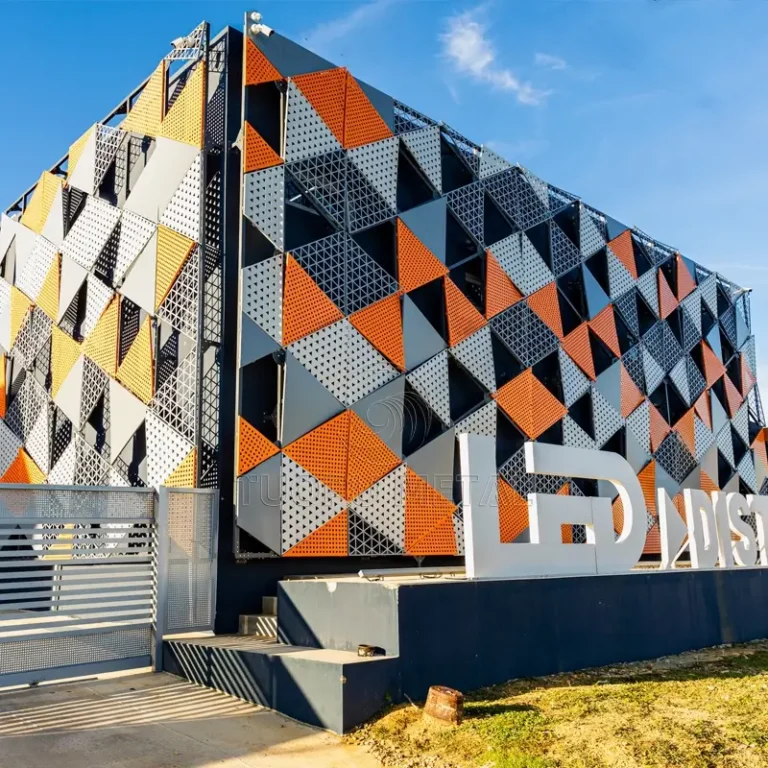
Aluminum’s workability allows for complex geometries including curved panels, custom perforation patterns, and integrated structural features. The AP300 perforated panel series from FstopMetal offers adjustable perforation rates, enabling architects to balance aesthetic transparency with structural rigidity. Steel can be perforated and formed as well, but requires more energy-intensive processing and carries greater risk of deformation during fabrication.
Acoustic and Ventilation Performance
Airport terminals demand careful attention to both acoustics and airflow management. Perforated panels serve a dual function in these environments: they contribute to sound absorption while permitting air circulation for HVAC efficiency.
Acoustic Performance
Perforated aluminum ceiling systems can achieve Noise Reduction Coefficient (NRC) ratings of 0.85 or higher when paired with appropriate acoustic backing materials such as mineral wool or foam inserts. This performance level is critical in terminal spaces where ambient noise from announcements, crowds, and mechanical systems requires mitigation. The open-cell structure of perforated panels allows sound waves to enter and dissipate within the backing material, reducing reverberation time across large volumes.
Ventilation and Airflow
Perforated aluminum panels are available with customizable open area ratios, making them suitable for ventilation applications where airflow must be maintained without compromising the architectural finish. In airport terminal ceilings, this enables integration with HVAC diffusers and smoke extraction systems while preserving a clean aesthetic. Steel perforated panels can achieve similar ventilation performance, but the weight penalty and corrosion considerations make aluminum the more practical choice for overhead installations.
Fire Compliance and Safety
Fire safety is a paramount concern in airport terminal design, governed by stringent building codes and aviation authority requirements.
Code Requirements and Testing Standards
Fire rating requirements vary by jurisdiction and project specification. Airport terminals typically fall under high-occupancy public assembly classifications, which impose specific requirements on facade and ceiling materials. The applicable standards may include ASTM E84 for surface burning characteristics, EN 13501 for classification by reaction to fire, or local building code equivalents. These requirements must be verified through third-party testing reports specific to the chosen panel configuration, substrate, and surface treatment.
Material Behavior in Fire
Aluminum has a melting point of approximately 660°C, meaning it will lose structural integrity at temperatures far below those encountered in a developed fire. This behavior must be accounted for in structural design and compartmentalization strategies. Steel retains strength at higher temperatures but can soften and deform under sustained thermal exposure. Neither material is inherently non-combustible in all configurations — the final fire performance depends on the complete assembly including backing materials, adhesives, and coatings. Fire rating requirements must be evaluated on a project-by-project basis with reference to third-party test reports and approved by the relevant authority having jurisdiction.
Lifecycle and Sustainability
Sustainability criteria are increasingly influential in public infrastructure procurement, and airport authorities worldwide are incorporating environmental performance into material selection.
Recycled Content and Circular Economy
Aluminum panels from FstopMetal can incorporate up to 75% recycled aluminum content, reducing the embodied carbon associated with primary production. At end of life, aluminum is 100% recyclable without degradation of properties, supporting circular economy objectives. Environmental Product Declarations (EPDs) are available for select product ranges, providing transparent lifecycle data for sustainability certification systems.
Operational Energy Savings
Perforated aluminum facade systems can contribute to operational energy efficiency through integrated ventilation strategies and compatibility with high-performance building envelope assemblies. Some product lines offer U-values as low as 0.8 W/m²K when configured as part of a ventilated curtain wall system, reducing heating and cooling loads in large terminal spaces.
Total Cost of Ownership
While upfront material costs vary between aluminum and steel based on market conditions, project specifications, and surface treatment requirements, the total cost of ownership often favors aluminum for airport applications. Lower maintenance requirements, reduced structural support costs due to lighter weight, and longer service life in corrosive environments contribute to favorable lifecycle economics. Steel may present a lower initial material cost in some markets, but protective coating systems, periodic maintenance, and potential replacement costs can narrow or reverse that advantage over the building lifecycle.
Specification and Procurement Considerations
When specifying perforated aluminum panels for airport terminals, the following factors should be addressed during the procurement process:
- Alloy and temper: 6063-T5 or 6063-T6 alloys provide appropriate strength for most cladding and ceiling applications.
- Perforation pattern and open area: Determined by architectural intent, acoustic requirements, and ventilation needs.
- Surface treatment: Powder coating, anodizing, or PVDF finishes selected based on environmental exposure and aesthetic specifications.
- Fire compliance documentation: Third-party test reports must be requested and verified against project code requirements.
- Quality certifications: CE marking for European projects, ISO 9001 for quality management, and SGS verification for material compliance.
- Custom fabrication: FstopMetal supports custom designs including curved panels, parametric perforation patterns, and integrated mounting systems.
- Export and logistics: The company ships to 36+ countries from its Foshan facility, with technical support and installation guidance available for international projects.
Frequently Asked Questions
Why is aluminum preferred over steel for airport terminal ceilings?
Aluminum’s lighter weight reduces structural loading on ceiling support systems, its natural corrosion resistance minimizes maintenance in high-traffic environments, and perforated aluminum ceiling systems can achieve high NRC ratings when paired with acoustic backing. These factors combine to make aluminum a practical and cost-effective choice for large-scale terminal installations.
Can perforated aluminum panels meet airport fire safety requirements?
Fire performance must be evaluated on a project-by-project basis according to the requirements of the applicable building code and aviation authority. Fire rating requirements vary by jurisdiction, and compliance must be verified through third-party test reports for the specific panel configuration, substrate, and surface treatment. Architects and contractors should request relevant test documentation from the manufacturer before specification.
What surface treatments are available for airport terminal applications?
Common surface treatments include powder coating (typically 60–80 microns), anodizing (15–25 microns), and PVDF coatings (25–30 microns). The choice depends on the environmental exposure, desired aesthetic, and maintenance strategy. Powder coating offers the widest color range, while anodizing provides a metallic finish with excellent UV resistance. Warranty coverage for surface treatments should be confirmed in the procurement contract.
Do perforated aluminum panels support acoustic requirements in large terminals?
Yes. Perforated aluminum ceiling panels can achieve NRC ratings of 0.85 or higher when combined with appropriate acoustic backing materials such as mineral wool or foam. The perforation rate and pattern are adjustable to balance acoustic performance with ventilation and aesthetic requirements. This makes them suitable for the demanding acoustics of airport terminals, where reverberation control is essential for passenger comfort and announcement intelligibility.
How does FstopMetal support international airport projects?
FstopMetal operates from Foshan, Guangdong, China, and exports to 36+ countries. The company provides custom fabrication services, technical support, and installation guidance for international projects. Certifications including ISO 9001, CE, and SGS are available, and EPD documentation can be provided for sustainability reporting. Minimum order quantities and delivery schedules vary by product and specification, so direct consultation with the sales team is recommended for project-specific requirements.