

What Determines the Cost of Aluminum Honeycomb Panels in 2026
The cost of aluminum honeycomb panels is driven by core material alloy and temper, panel thickness and overall dimensions, surface treatment type and coating thickness, honeycomb core density and cell size, and order volume with customization complexity. FstopMetal manufactures these panels in Foshan, Guangdong, China, and pricing for any project must be confirmed directly with the sales team based on the specific specification package.
Alloy, Temper, and Core Construction
The aluminum alloy and its temper form the single most influential cost variable in a honeycomb panel. Panels built from 6063-series alloy in T5 or T6 temper offer a well-understood balance of formability and structural rigidity that architects and specifiers rely on for facades, ceilings, and interior partitions. Moving to a higher-strength temper or a different alloy grade raises material cost, but it can also allow thinner faces or larger unsupported spans — a trade-off that must be evaluated on a per-project basis.
The honeycomb core itself is another decisive factor. Core aluminum alloy, cell size, and core density all affect both weight and price. A finer cell structure and higher core density improve flatness and point-load resistance but increase material usage per square meter. Panels intended for high-traffic flooring or heavy cladding applications typically require a denser core, which moves the cost upward relative to lightweight ceiling or interior-partition panels.
- Standard 6063-T5 cores are the baseline option for most curtain-wall and ceiling applications.
- 6063-T6 temper raises core strength and may reduce required face-sheet thickness.
- Higher core density improves impact resistance but increases cost per square meter.
- Larger cell sizes reduce material use but can compromise surface flatness under load.
Surface Treatment and Coating Thickness
Surface treatment is where specification choices most visibly diverge in cost. The three primary finishes available from FstopMetal are powder coating, anodizing, and PVDF, each with different performance profiles and price positions.
| Surface Treatment | Typical Coating Thickness | Key Characteristics | Relative Cost Position |
|---|---|---|---|
| Powder Coating | 60–80 microns | Wide color range, good durability | Baseline |
| Anodizing | 15–25 microns | Metallic appearance, excellent UV resistance | Premium over powder |
| PVDF | 25–30 microns | Superior chalk and fade resistance for exterior facades | Premium over powder |
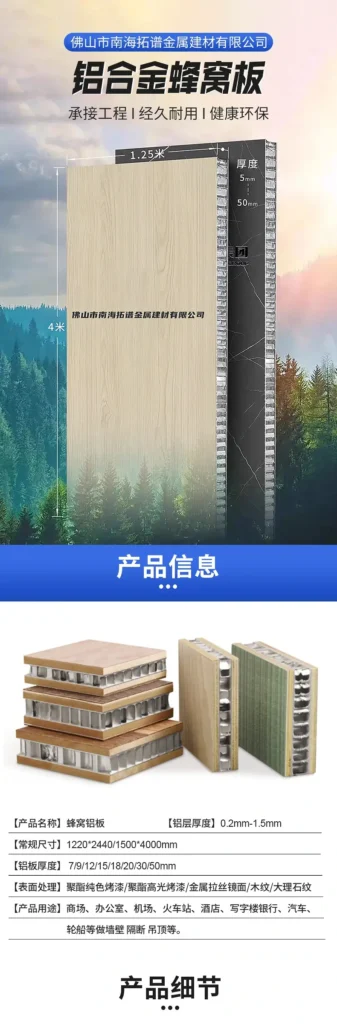
| Wood Grain Transfer | Standard | Decorative wood appearance on aluminum | Varies by pattern complexity |
Coating thickness directly affects both performance and cost. A 60-micron powder coat will cost more than a 40-micron application, and it will generally deliver better film integrity and longer service performance in aggressive environments. For coastal or high-pollution sites, specifiers often move to PVDF or a thicker powder system, accepting the higher unit cost in exchange for reduced maintenance risk over the building life.
Wood grain transfer adds a decorative layer on top of the base coating and introduces additional process steps, so panels with wood grain finishes typically carry a cost premium over solid-color equivalents. The premium varies with pattern complexity and whether a custom color match is required.
Panel Geometry, Thickness, and Custom Fabrication
Panel geometry is a major cost lever that is sometimes overlooked during early budgeting. Flat panels are the most economical form. Curved panels, such as those in the AP200 series, require additional forming operations and tooling, which raises the unit cost. Perforated panels, found in the AP300 series, involve punching or laser cutting that scales with perforation rate — a 40 percent open area costs more than a 15 percent open area because more aluminum must be removed and the punching process runs slower.
Overall panel thickness is equally important. A 25 mm honeycomb panel uses more core material and more face sheet than a 15 mm panel of the same face alloy, and the weight difference also affects handling and installation costs on site. For curtain-wall applications where wind load and deflection criteria drive the spec, the required panel thickness may be determined by engineering rather than aesthetics, and that engineering-driven thickness is a direct cost input.
- Flat panels are the lowest-cost geometry.
- Curved or radiused panels require additional forming and carry a premium.
- Perforation rate scales cost with open area — higher perforation means higher cost.
- Greater panel thickness increases material use and unit price.
- Custom sizes outside standard sheet dimensions typically incur a fabrication premium.
Volume, Logistics, and Project-Specific Factors
Order volume is one of the most practical cost drivers. Larger orders spread setup, tooling, and quality-inspection costs over more square meters, reducing the per-unit price. Smaller or phased orders, which are common in renovation and fit-out projects, will carry a higher effective unit cost because the same fixed processes are repeated across smaller batches.
Logistics from Foshan to North American or European project sites adds a significant cost layer that is independent of the panel specification. Sea freight rates, insurance, customs documentation, and destination-port charges all vary by route and by timing. Panels specified with EPD certification or particular recycled-content claims may also involve additional documentation costs, though FstopMetal offers EPD-compliant options for projects that require environmental product declarations.
| Cost Driver | How It Moves Price | Typical Mitigation |
|---|---|---|
| Order volume | Higher volume lowers per-unit cost | Consolidate phases where possible |
| Panel geometry | Curved and perforated panels cost more | Standardize geometries across elevations |
| Surface treatment | PVDF and anodizing carry premiums | Match treatment to exposure severity, not aesthetics alone |
| Logistics | Freight varies by route and fuel surcharges | Plan shipments to align with construction schedule |
| Custom sizes | Non-standard dimensions increase fabrication time | Design to standard sheet modules where structurally acceptable |
How to Evaluate Total Cost, Not Just Unit Price
A low unit price on aluminum honeycomb panels can mask higher total project cost if the specification forces more frequent replacement, heavier structural support, or more complex installation. Panels with higher recycled aluminum content — FstopMetal offers options with up to 75 percent recycled content — may carry a modest material premium but can contribute to sustainability credits and reduce the embodied carbon of the facade or ceiling system.
Thermal performance is another total-cost consideration. Honeycomb panels with low U-values, such as those reaching down to 0.8 W/m²K in suitable configurations, can reduce HVAC loads over the building life. For curtain-wall and BIPV-integrated facades, the energy-performance benefit of a well-specified honeycomb panel can offset a higher initial material cost over time.
Acoustic performance follows a similar logic. Ceiling and partition honeycomb panels paired with perforated faces and sound-absorbing backing can achieve NRC ratings of 0.85 or higher, reducing the need for additional acoustic treatment in spaces such as airports, hospitals, and open-plan offices. The integrated solution may cost more upfront than a bare panel, but it simplifies the MEP and interior-finish coordination.
When comparing quotes, buyers should ensure that each supplier is pricing the same specification package — same alloy temper, same face thickness, same core density, same coating type and micron thickness, and same geometry. A quote that appears significantly lower may reflect a thinner face sheet, a lower core density, or a thinner coating, any of which can compromise long-term performance.
Frequently Asked Questions
What is the biggest single cost driver for aluminum honeycomb panels?
The biggest cost driver is typically the combination of panel geometry and surface treatment. Curved or perforated panels require additional fabrication steps, and PVDF or anodized finishes carry a premium over standard powder coating. These two variables together usually account for the largest spread between a baseline quote and a fully specified quote.
Does thicker coating always mean better value?
Not always. A thicker coating improves durability in aggressive environments, but spec’ing a 80-micron powder coat on an interior ceiling panel that will never be exposed to weather is unnecessary and raises cost without proportional benefit. The right coating thickness depends on the exposure classification of the application, not on a universal maximum.
How does recycled aluminum content affect panel cost?
Recycled aluminum content is available at up to 75 percent in FstopMetal’s product range. Panels with higher recycled content may carry a modest premium depending on alloy and temper, but they can deliver significant embodied-carbon reductions and support EPD documentation. The cost impact should be weighed against the project’s sustainability targets and any green-building credit requirements.
Can I reduce cost by standardizing panel sizes?
Yes. Standard panel dimensions minimize fabrication time and reduce material waste from cutting non-standard sheets. Where architectural design allows, aligning panel sizes to standard sheet modules can lower both the unit price and the lead time, because the production line runs more efficiently with repeatable sizes.
Why do quotes for the same panel type vary between suppliers?
Quotes vary because suppliers may be pricing different alloy tempers, different face-sheet thicknesses, different core densities, or different coating systems. Always compare the full specification — alloy, temper, face thickness, core density, coating type, and coating thickness — not just the per-square-meter price. A lower quote that omits any of these parameters is not a like-for-like comparison.