



Direct Answer
Perforation rate is the single most influential variable in the acoustic performance of a perforated aluminum panel. As open area increases, sound transmission rises while sound absorption initially improves—until a balance point is reached. For architectural applications, perforation rates between 15% and 35% typically deliver the optimal combination of acoustic absorption (NRC 0.60–0.85+) and structural integrity, depending on panel thickness, backing material, and cavity depth.
Understanding Perforation Rate and Its Acoustic Mechanics
Perforation rate, expressed as a percentage of open area relative to total panel surface area, governs how sound waves interact with the panel. When sound encounters a perforated aluminum panel, a portion reflects off the surface, a portion passes through the holes, and a portion is dissipated as thermal energy within the perforation channels and any absorptive backing.
The Three-Stage Acoustic Response
- Low perforation rates (5–15%): The panel behaves predominantly as a reflective surface. Sound transmission loss is moderate, but absorption is limited. These configurations are suitable where visual subtlety is required and acoustic treatment is provided by other building elements.
- Medium perforation rates (15–35%): This is the primary design window for acoustic applications. The increased open area allows sound energy to enter the panel cavity, where it interacts with absorptive backing materials. NRC values in this range typically span 0.60 to 0.85+, making these panels effective for noise reduction in occupied spaces.
- High perforation rates (35–60%): Maximum acoustic absorption is approached, but structural rigidity decreases and sound transmission increases. These rates are used where visual openness and ventilation take priority, or where the panel functions as part of a multi-layer acoustic assembly.
Resonance and Hole Geometry
Perforation rate alone does not determine acoustic performance. Hole diameter, pattern layout, and panel thickness collectively define the resonant frequency of the assembly. Smaller-diameter holes shift resonance toward higher frequencies, while larger holes and thicker panels target mid-to-low frequency absorption. The AP300 perforated panel series from FstopMetal is engineered with variable perforation patterns to address these frequency-dependent requirements across commercial and institutional projects.
Panel Thickness, Backing Materials, and Cavity Depth
Perforation rate must be evaluated in conjunction with three other critical parameters: substrate thickness, backing material, and the air cavity behind the panel. These factors interact to determine the final acoustic rating of the assembly.
Substrate Thickness and Stiffness
Thicker aluminum substrates (typically 2.0 mm to 6.0 mm for architectural panels) provide greater structural stiffness, which is essential when perforation rates exceed 25%. The AP Series solid and perforated panels utilize 6063-T5 or 6063-T6 aluminum alloy, delivering the strength necessary to maintain flatness and dimensional stability across large spans even at higher perforation rates.
Backing Material Selection
| Backing Material | NRC Contribution | Best Application |
|---|---|---|
| Open backing (no fill) | 0.10 – 0.25 | Ventilation-focused facades |
| Polymer foam fill | 0.40 – 0.65 | Commercial interiors, retail |
| Mineral wool fill | 0.60 – 0.85+ | Airports, hospitals, classrooms |
| Composite honeycomb core | 0.50 – 0.70 | High-span curtain wall applications |
Air Cavity Depth
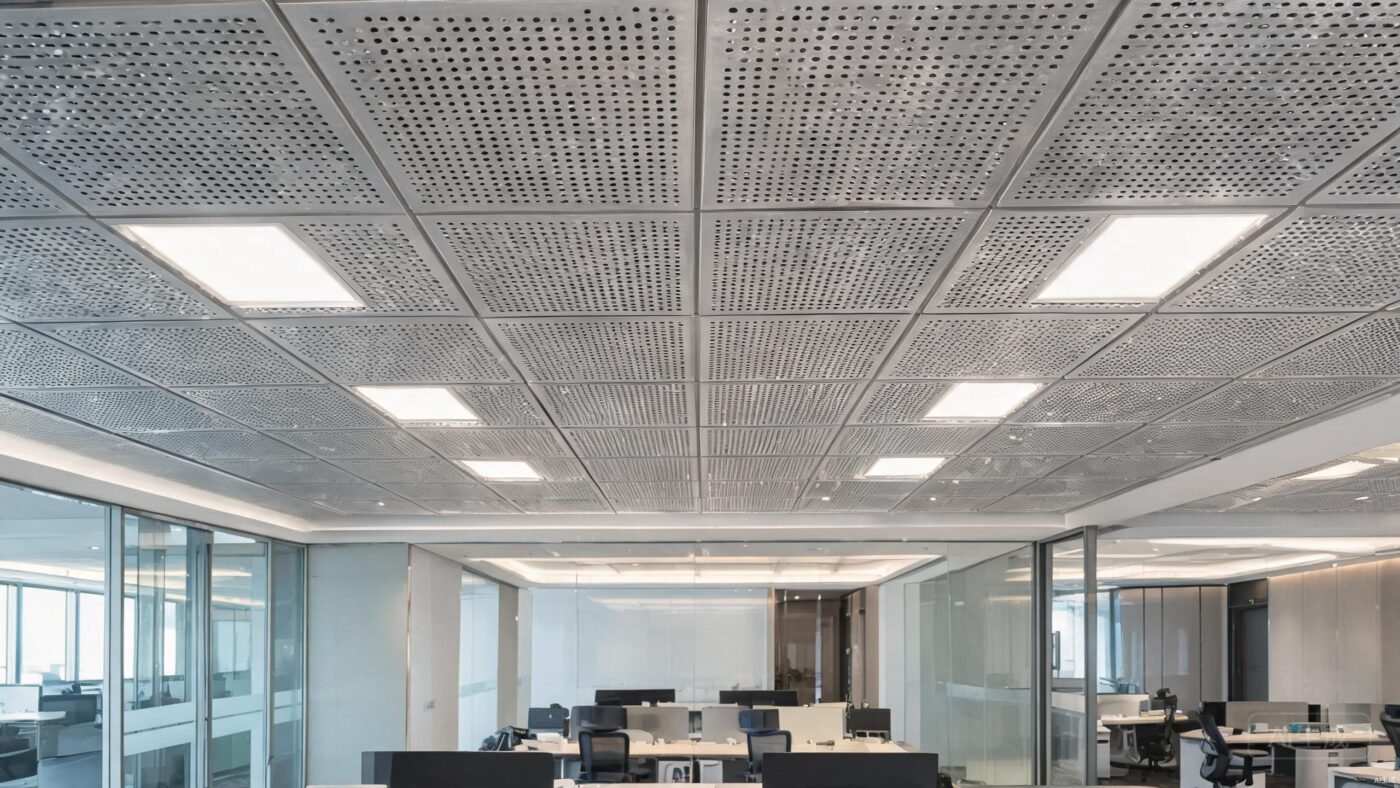
The depth of the air space between the perforated panel and the solid backing wall or sheathing is a decisive factor. A deeper cavity (100 mm to 300 mm) lowers the resonant frequency, improving low-frequency absorption. Shallow cavities (25 mm to 50 mm) are effective primarily at mid-to-high frequencies. For ceiling applications in airports and transportation hubs, cavity depths of 150 mm to 250 mm with mineral wool fill routinely achieve NRC ratings above 0.85.
Perforation Patterns and Their Acoustic Impact
The geometric arrangement of perforations—round, square, slot, or custom parametric patterns—affects both the effective open area and the acoustic behavior across frequency bands.
Round vs. Slot Perforations
- Round holes provide uniform acoustic performance across all incident angles and are the standard choice for ceiling and wall applications where sound arrives from multiple directions.
- Slot perforations offer directionally dependent absorption, with higher performance along the axis perpendicular to the slot length. They are commonly specified for facade applications where wind-driven rain resistance and visual linear aesthetics are priorities.
Parametric and Custom Perforation Designs
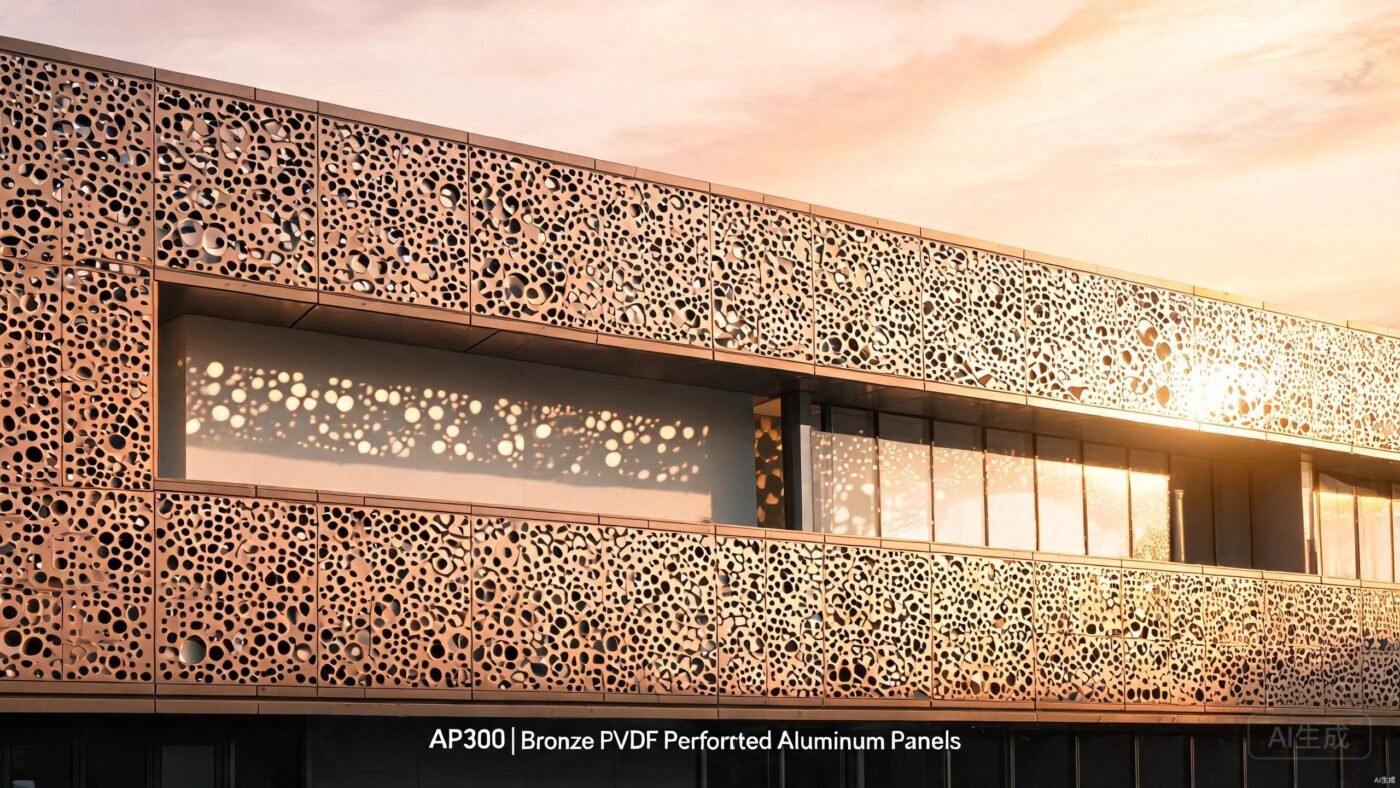
For facades and feature ceilings, perforation rate can be varied across the panel surface to create gradient acoustic zones. Denser perforation in high-noise areas and reduced perforation in quieter zones allows designers to tailor acoustic performance spatially. The AP300 series supports custom parametric perforation layouts, enabling architects to achieve both aesthetic intent and targeted NRC performance within a single panel run.
Specifying Perforated Aluminum Panels for Acoustic Performance
When specifying perforated aluminum panels for acoustic applications, the following parameters must be defined to ensure the installed assembly meets the project’s noise reduction targets.
Key Specification Parameters
- Target NRC: Define the required noise reduction coefficient based on the space type. Classrooms and healthcare facilities typically require NRC 0.80+, while retail and office spaces may specify NRC 0.60 to 0.75.
- Perforation rate: Select the open area percentage that balances acoustic performance with structural and aesthetic requirements. Rates between 15% and 35% cover the majority of architectural applications.
- Panel thickness: Specify substrate thickness based on span requirements and perforation rate. Higher perforation rates generally require thicker substrates to maintain rigidity.
- Backing configuration: Specify the absorptive backing material and cavity depth. Mineral wool fill with a 150 mm to 250 mm cavity is the standard for high-performance acoustic ceilings.
- Surface finish: Powder coating (60–80 microns) provides a 25- to 30-year warranty and is suitable for both interior and exterior applications. PVDF coatings offer enhanced color retention for exterior facades.
- Fire rating: For applications requiring A2-s1-d0 classification, specify non-combustible backing materials and verify that the complete assembly meets the relevant fire code.
Integration with Building Envelope Systems
Perforated aluminum panels used in curtain wall applications must be coordinated with the overall wall assembly. The AP series unitized curtain wall systems, which are factory-pre assembled, integrate perforated panels with thermal breaks, weather barriers, and insulating cavities to deliver both acoustic performance and thermal efficiency. U-values as low as 0.8 W/m²K are achievable with properly specified multi-layer assemblies.
Sustainability and Long-Term Performance
Perforated aluminum panels offer significant sustainability advantages that complement their acoustic function. Aluminum is 100% recyclable without loss of material properties, and FstopMetal panels contain up to 75% recycled aluminum content. The long service life of powder-coated and PVDF-finished panels—typically 25 to 30 years—reduces the frequency of replacement and associated embodied carbon. Environmental Product Declarations (EPD) are available for select product lines, supporting LEED and BREEAM certification credits.
Operating since 2003 from a 15,000 m² facility in Foshan, Guangdong, China, FstopMetal supplies CE, SGS, and ISO 9001 certified aluminum facade and ceiling systems to projects in 36+ countries. The AP300 perforated panel, G100 and G200 pergola series, and unitized curtain wall systems are engineered for the performance demands of airports, hospitals, educational facilities, and commercial buildings across North America and Europe.
Frequently Asked Questions
What perforation rate is optimal for acoustic ceiling applications?
For most acoustic ceiling applications, a perforation rate between 20% and 30% provides the best balance of sound absorption and structural performance. When paired with mineral wool backing and a 150 mm to 250 mm air cavity, this range typically achieves NRC ratings of 0.75 to 0.85+. Lower rates may be specified where visual subtlety is prioritized, while higher rates are used in ventilation-intensive facade applications.
Does hole size affect the NRC rating of a perforated panel?
Yes. Hole diameter influences the resonant frequency of the panel assembly. Smaller holes (2 mm to 4 mm) resonate at higher frequencies and are effective for mid-to-high frequency absorption. Larger holes (5 mm to 10 mm) shift absorption toward lower frequencies. The combination of hole size, perforation rate, and backing material determines the overall NRC and frequency-specific absorption profile.
Can perforated aluminum panels meet A2 fire rating requirements?
Yes. Perforated aluminum panels can be specified with A2-s1-d0 fire classification when paired with non-combustible backing materials such as mineral wool. The aluminum substrate itself is non-combustible, and the overall assembly rating depends on the complete wall or ceiling construction. FstopMetal’s AP series panels are available with A2-grade fire classification for projects requiring European fire performance standards.
How does panel thickness influence acoustic and structural performance?
Panel thickness affects both rigidity and acoustic resonance. Thicker substrates (4 mm to 6 mm) maintain flatness and resist deflection at higher perforation rates, which is critical for large-span ceiling and facade installations. Thinner panels (2 mm to 3 mm) are suitable for lower perforation rates and shorter spans. Acoustically, increased thickness raises the natural frequency of the panel, which can slightly reduce low-frequency absorption unless compensated by deeper cavities or denser backing materials.
What is the typical delivery timeline for custom perforated acoustic panels?
Standard perforated panel configurations typically ship within 15 to 30 days. Custom perforation patterns, parametric designs, and specialized backing assemblies require 30 to 60 days depending on complexity. FstopMetal provides technical support and installation guidance for international projects, and unitized curtain wall systems are factory-pre assembled to accelerate on-site installation by up to 40% compared to stick-built systems.