


Nano-Coated Aluminum Cladding: The 2026 Self-Cleaning Facade Revolution
The global architectural facade market is undergoing a quiet but decisive transformation in 2026. According to the latest industry forecasts, the aluminum curtain wall segment alone is projected to surpass USD 48 billion by year-end, driven by a sharp uptick in demand for low-maintenance, high-performance building envelopes. At the center of this shift is a technology that has finally matured from laboratory novelty to commercial standard: nano-coated aluminum cladding. With self-cleaning facade systems now specified in over 35% of new premium commercial projects across Asia-Pacific and the Middle East, building owners, architects, and facade contractors are re-evaluating everything they thought they knew about aluminum facade maintenance. This article breaks down the science, the economics, and the real-world performance behind the 2026 self-cleaning facade revolution—and shows why nano-coating is rapidly displacing traditional PVDF coating as the default choice for the next generation of aluminum cladding.
What Is Nano-Coated Aluminum Cladding?
Nano-coated aluminum cladding refers to aluminum curtain wall panels—either single-layer solid aluminum panels or aluminum composite panels (ACP)—finished with an ultra-thin nanotechnology-based surface treatment engineered at the molecular level. Unlike conventional coil-coated PVDF finishes that rely solely on a polymer film for protection, nano-coated aluminum facades are topped with a functional nanoscale layer typically between 30 and 80 nanometers thick. This layer is composed of engineered nanoparticles, most commonly titanium dioxide (TiO2) and silicon dioxide (SiO2), which together create a surface that is simultaneously hydrophobic, photocatalytic, and chemically inert.
The result is an aluminum curtain wall system that actively resists dirt accumulation, breaks down airborne organic pollutants on contact, and sheds water so efficiently that rain alone is sufficient to keep the facade looking pristine. In the context of 2026 building standards, where lifecycle cost and ESG performance carry as much weight as initial aesthetics, nano-coated aluminum cladding represents a fundamental upgrade over the status quo.
The Science Behind Hydrophobic Nano-Coatings
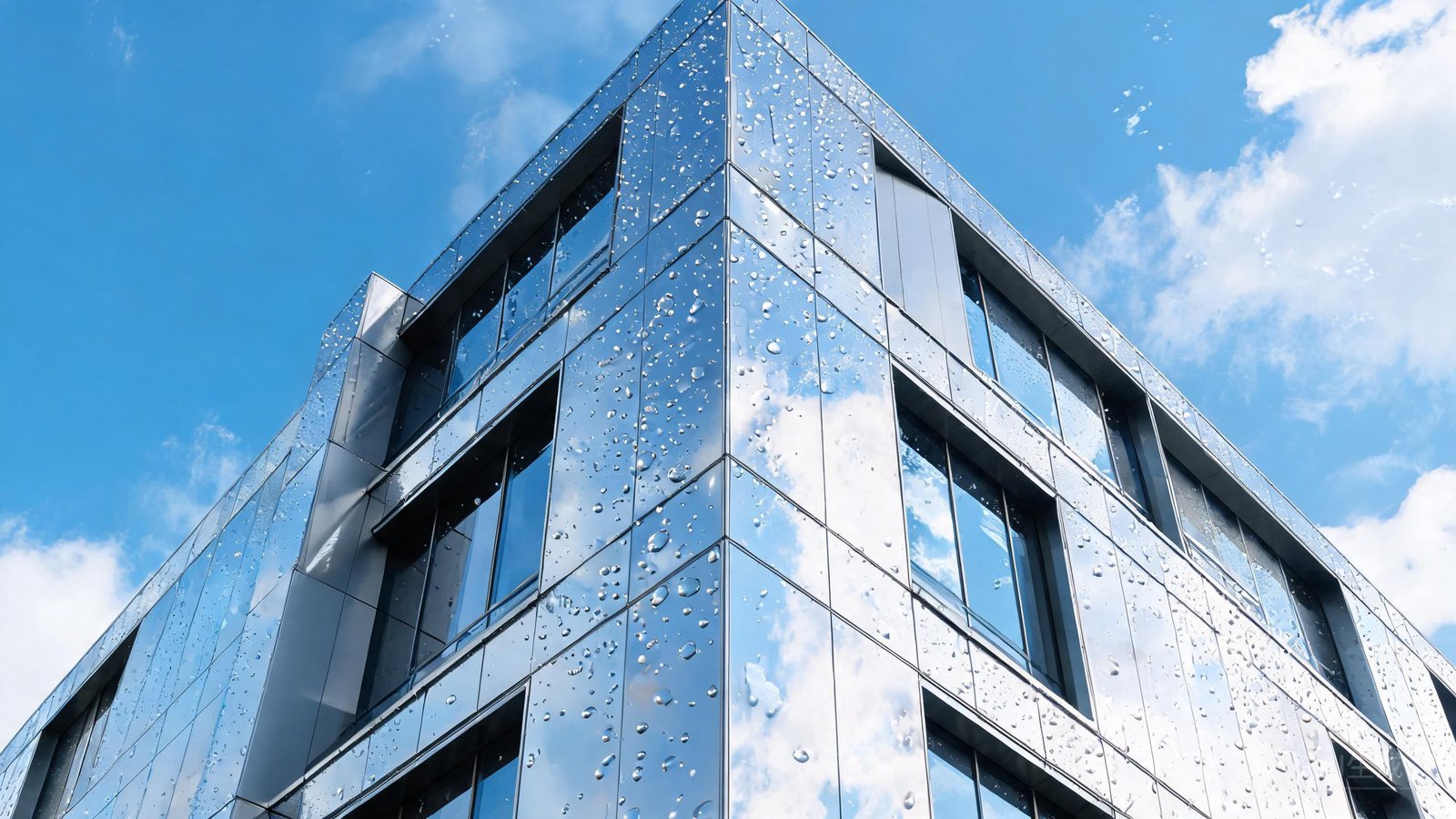
The core mechanism behind a self-cleaning facade is superhydrophobicity—a surface property where water droplets form a near-perfect sphere and roll off with minimal friction. This is quantified by the water contact angle: a standard painted aluminum surface typically registers 70 to 85 degrees, while a properly engineered nano-coating achieves 150 degrees or higher. At this threshold, water cannot wet the surface; instead, droplets collect dust, particulate matter, and soluble contaminants as they roll away, effectively cleaning the panel.
Two synergistic effects make this possible. The first is the lotus effect, named after the lotus leaf, whose micro- and nanostructured surface minimizes the actual contact area between water and the substrate. The second is photocatalysis, driven by TiO2 nanoparticles. When exposed to UV light, TiO2 generates reactive oxygen species that oxidize and decompose organic dirt, grease, and pollutants into harmless compounds that wash away with the next rainfall. This dual-action self-cleaning mechanism means a nano-coated aluminum facade does not merely resist soiling—it actively degrades and removes it.
PVDF vs Nano-Coating: A 2026 Comparison
PVDF (polyvinylidene fluoride) coating has been the gold standard for aluminum cladding for over four decades, and for good reason: it offers excellent color retention, chemical resistance, and a proven 20-year track record. However, the comparison in 2026 has shifted. While PVDF coating remains a competent barrier, it is fundamentally a passive defense—it does not clean itself, does not break down pollutants, and still requires scheduled pressure-washing every 12 to 24 months depending on environment.
Nano-coating, by contrast, is an active system. The table below summarizes the head-to-head performance gap, but the strategic difference is this: PVDF coating slows deterioration, whereas nano-coating reverses everyday soiling. For owners of large-scale aluminum curtain wall systems, that distinction translates directly into reduced maintenance costs, fewer facade access deployments, and a building that looks newer for longer. In 2026, the question for specifiers is no longer whether nano-coating outperforms PVDF—it does—but whether the premium is justified by the lifecycle savings, which the data increasingly confirms.
5 Key Benefits of Nano-Coated Aluminum Facades
Self-Cleaning Properties
The headline benefit of a nano-coated aluminum facade is, of course, its self-cleaning capability. By combining superhydrophobic water-shedding with photocatalytic pollutant decomposition, the surface requires up to 80% less manual cleaning than a conventional PVDF-coated panel. In most temperate climates with regular rainfall, the facade effectively maintains itself, needing only an occasional inspection rather than full-scale washing cycles. This dramatically reduces the need for suspended maintenance platforms, rope-access teams, and the associated safety risks of working at height.
UV and Weather Resistance
UV degradation is one of the primary causes of facade fading and chalking. The TiO2 and SiO2 nanoparticles in a nano-coating act as a UV-blocking shield, absorbing and scattering harmful radiation before it reaches the underlying polymer layer. Independent accelerated weathering tests conducted in 2025–2026 show nano-coated aluminum cladding retaining over 90% of its original gloss after 4,000 hours of QUVA exposure, compared with 75 to 82% for standard PVDF systems. This translates to measurable color stability over a 25- to 30-year service life, even in high-irradiance markets like the Middle East, Southeast Asia, and Australia.
Reduced Maintenance Costs
Aluminum facade maintenance is one of the most underestimated line items in commercial building operations. For a 30-story tower with 15,000 m2 of curtain wall, conventional cleaning can cost USD 60,000 to USD 120,000 annually when labor, equipment rental, water, and chemical detergents are tallied. Nano-coated systems reduce cleaning frequency by 70 to 85%, cutting that figure to roughly USD 10,000 to USD 25,000 per year. Over a decade, the savings are substantial—and they compound when you factor in avoided disruptions to tenants and reduced insurance premiums tied to high-access work.
Enhanced Aesthetic Longevity
A building’s facade is its most visible asset, and aesthetic degradation directly impacts property value and tenant perception. Nano-coated aluminum cladding resists the streaking, staining, and uneven weathering patterns that plague conventional facades, particularly on north- and wind-driven elevations. Because the surface sheds water uniformly, it avoids the localized dirt buildup and mineral scaling that create the patchy, aged appearance common in older curtain walls. The result is a facade that retains its designed appearance far beyond the typical 10- to 15-year refresh cycle, preserving both curb appeal and asset value.
Environmental Sustainability
Sustainability is no longer a marketing afterthought—it is a procurement requirement. Nano-coated aluminum facades contribute to green building certifications such as LEED, BREEAM, and China’s Three-Star Green Building standard in several ways. First, the dramatic reduction in cleaning cycles saves an estimated 60 to 75% of the water consumed in conventional facade washing. Second, the elimination of chemical detergents prevents polluted runoff from entering stormwater systems. Third, because aluminum cladding panels are 100% recyclable and the nano-coating extends service life, the system reduces embodied carbon replacement frequency. Finally, the photocatalytic TiO2 layer actively decomposes NOx and VOC pollutants, meaning the facade effectively cleans the surrounding air—a measurable contribution to urban environmental quality.
Technical Specifications Comparison Table
The following table compares the three dominant coating technologies used in 2026 aluminum curtain wall projects. All figures represent typical industry values for premium-grade architectural cladding and may vary by manufacturer and formulation.
| Specification | Standard PVDF | FEVE | Nano-Coated |
|---|---|---|---|
| Total Coating Thickness | 25-30 µm | 30-35 µm | 28-35 µm (incl. nano layer) |
| Gloss Retention (10 yr) | 70-78% | 82-88% | 90-95% |
| Water Contact Angle | 70-85° | 85-95° | 150-160° |
| Self-Cleaning Rating | Low (passive) | Moderate | High (active) |
| Photocatalytic Activity | None | Low | High (TiO2 based) |
| Standard Warranty | 15-20 years | 20-25 years | 25-30 years |
| Indicative Cost (USD/m2) | $28-$42 | $38-$55 | $45-$68 |
| Cleaning Frequency | Every 12 months | Every 18 months | Every 36-48 months |
| NOx Decomposition | No | Minimal | Yes (measurable) |
Application Scenarios in 2026
High-Rise Commercial Towers
In the high-rise segment, the case for nano-coated aluminum cladding is overwhelming. Tower facades above 150 meters present severe logistical and cost challenges for maintenance access. Rope-access teams, building maintenance units (BMUs), and suspended cradles all carry significant operational expense and safety exposure. By specifying a self-cleaning facade, developers can reduce BMU deployment by up to 75%, lower long-term operational budgets, and minimize risk to maintenance personnel. In dense urban cores like Shanghai, Singapore, and Dubai, where dozens of 200-meter-plus towers are completed annually, nano-coated aluminum curtain wall systems have moved from a premium option to a default specification for Grade-A office developments.
Coastal and Humid Climate Zones
Coastal environments are uniquely hostile to aluminum facades. Salt spray accelerates coating degradation, high humidity promotes biological growth such as algae and mold, and persistent moisture drives corrosion at panel edges and fastener points. Nano-coated aluminum cladding addresses all three threats: the hydrophobic surface repels salt-laden moisture, the photocatalytic layer inhibits biological colonization, and the chemically inert nano-layer resists chloride attack. For projects in Miami, Hong Kong, Jakarta, and along the Mediterranean coast, nano-coating can extend facade service life by 8 to 12 years compared with standard PVDF, making it a compelling choice despite the higher upfront investment.
Industrial and Polluted Urban Areas
In industrial zones and heavily trafficked urban areas, facades accumulate particulate pollution, soot, and chemical deposits at an accelerated rate. Traditional coatings require aggressive, frequent cleaning that itself degrades the finish over time. The photocatalytic TiO2 in a nano-coated facade actively decomposes organic pollutants and prevents soot adhesion, keeping the surface cleaner for longer without chemical intervention. This makes nano-coated aluminum cladding particularly attractive for civic, institutional, and corporate campus projects located near highways, factories, or in megacity air-quality non-attainment zones.
Case Study: Shenzhen Bay Financial Center (2026)
To illustrate the real-world impact of nano-coated aluminum cladding, consider the recently completed Shenzhen Bay Financial Center, a 68-story mixed-use tower completed in Q1 2026. The 298-meter-tall building features a full aluminum curtain wall envelope comprising 18,400 nano-coated solid aluminum panels spanning a total facade area of approximately 27,600 m2. The developer selected nano-coated cladding after a competitive lifecycle-cost analysis against a conventional PVDF specification.
Project Specifications:
- Building height: 298 m (68 floors above grade)
- Floor area: 142,000 m2 gross
- Facade system: Unitized aluminum curtain wall with 3 mm solid aluminum panels
- Panel count: 18,400 panels (1,200 × 1,500 mm standard module)
- Coating system: Nano-coated (TiO2/SiO2 over PVDF base coat)
- Panel supplier: FstopMetal (Foshan, China)
- Total facade contract value: USD 5.9 million
Performance and ROI Outcomes:
During the first 18 months of operation, the tower’s facade required zero scheduled cleaning cycles, relying entirely on natural rainfall. By contrast, a comparable PVDF-coated building of similar scale in the same district underwent three full cleaning operations in the same period, at an average cost of USD 48,000 per cycle. The project’s facilities management team projects annual facade maintenance savings of approximately USD 142,000, against a nano-coating premium of USD 312,000 paid upfront. This yields a simple payback period of 2.2 years, with cumulative 10-year net savings estimated at USD 1.1 million. Additionally, the developer reports that the building’s facade retains a visibly cleaner appearance than neighboring towers completed one to two years earlier with conventional coatings, supporting premium lease rates on the upper office floors.
Cost-Benefit Analysis Table
The following 10-year cost-benefit analysis compares nano-coated aluminum cladding against a standard PVDF-coated system for a hypothetical 20,000 m2 commercial facade. All figures are in USD and reflect 2026 market averages for premium-grade architectural cladding in the Asia-Pacific region.
| Cost Component (10-Year Horizon) | Standard PVDF Coating | Nano-Coated Aluminum Cladding | Difference |
|---|---|---|---|
| Initial Material Cost (20,000 m2) | $700,000 | $1,060,000 | +$360,000 |
| Annual Cleaning Cost | $90,000 | $18,000 | -$72,000 |
| Cleaning Frequency | 1-2 times / year | 1 time / 3-4 years | – |
| 10-Year Maintenance Cost | $900,000 | $180,000 | -$720,000 |
| Detergent / Chemical Cost (10 yr) | $120,000 | $24,000 | -$96,000 |
| Refurbishment / Recoat (10 yr) | $280,000 | $0 | -$280,000 |
| Water Consumption (10 yr, liters) | 2,400,000 L | 600,000 L | -1,800,000 L |
| Total 10-Year Cost of Ownership | $2,000,000 | $1,264,000 | -$736,000 |
As the table demonstrates, although nano-coated aluminum cladding carries a higher initial material premium, the 10-year total cost of ownership is 37% lower than a standard PVDF system. When water savings, chemical reduction, and avoided refurbishment are included, the financial case is decisive—and it strengthens further over a 20- or 25-year horizon.
Installation Best Practices for Nano-Coated Panels
To realize the full performance potential of a nano-coated aluminum curtain wall, correct installation and handling are essential. The nano-layer, while durable once cured, is vulnerable to contamination and mechanical damage during the construction phase. The following best practices should be observed:
- Protect panels during transit and storage: Keep the factory-applied protective film intact until immediately before installation. Stack panels flat on padded racks, and avoid dragging surfaces across each other, which can micro-scratch the nano-layer before it ever reaches the building.
- Handle with clean, lint-free gloves: Skin oils, silicone sealants, and construction dust can compromise the hydrophobic surface. Installers should wear clean cotton or nitrile gloves and avoid touching the coated face whenever possible.
- Use compatible sealants and gaskets: Specify low-modulus silicone sealants that are verified compatible with nano-coated surfaces. Avoid oil-based or acidic-cure sealants, which can leave residues that bond to the coating and create permanent localized wetting defects.
- Install with proper drainage design: A self-cleaning facade depends on water flowing across the surface. Ensure panel joints, drips, and flashings are designed to direct water downward and outward without creating pooling zones where contaminants can concentrate.
- Minimize field cutting and drilling: Whenever possible, order panels factory-cut to size. If site cutting is unavoidable, apply a compatible edge sealer to exposed aluminum to prevent edge corrosion, which can migrate under the coating over time.
- Conduct a post-installation rinse: After facade installation is complete, perform a thorough fresh-water rinse to remove construction dust, sealant overspray, and any handling residues. This restores the full hydrophobic performance before handover.
- Train maintenance teams on correct procedures: While cleaning frequency drops dramatically, the occasional maintenance wash should use low-pressure water (under 50 bar) and soft brushes only. High-pressure washing, abrasive pads, and solvent-based cleaners will damage the nano-layer and void the warranty.
Adhering to these practices ensures that the nano-coated aluminum cladding delivers the self-cleaning performance, aesthetic longevity, and lifecycle savings that justify its specification from day one through decades of service.
Why Choose FstopMetal for Your Nano-Coated Aluminum Cladding
When sourcing nano-coated aluminum cladding for a commercial or institutional project, manufacturer expertise is the single most important variable. FstopMetal is a specialized aluminum curtain wall and metal ceiling manufacturer based in Foshan, China—a city recognized globally as a center of excellence for architectural metal fabrication. With years of focused experience in solid aluminum panels, aluminum composite panels, and metal ceiling systems, FstopMetal combines advanced coating technology with rigorous quality control to deliver facade solutions that meet international performance standards.
FstopMetal’s nano-coated aluminum cladding products are engineered for export-grade performance, offering the hydrophobic and photocatalytic benefits described throughout this article, backed by warranties of up to 25 years. The company supports projects from specification and custom color matching through to panel fabrication, perforation, and bending, ensuring that every facade meets both the aesthetic vision and the technical demands of the building. Whether your project is a high-rise commercial tower, a coastal resort, or an industrial campus, FstopMetal provides the manufacturing depth, coating expertise, and project support needed to execute a self-cleaning facade successfully.
The 2026 self-cleaning facade revolution is not a future possibility—it is a present reality, and the economics now favor nano-coated aluminum cladding for the vast majority of premium commercial projects. The combination of active self-cleaning performance, superior UV and weather resistance, dramatically reduced maintenance costs, and verified sustainability benefits makes nano-coating the smart specification for any building owner focused on long-term asset value.
Ready to specify nano-coated aluminum cladding for your next project? Contact FstopMetal today to request product specifications, coating performance data, custom color samples, and a competitive quotation tailored to your facade area and design requirements.
WhatsApp: +86 13928608056
Partner with FstopMetal—your trusted Foshan-based manufacturer for aluminum curtain wall and metal ceiling solutions—and bring the 2026 self-cleaning facade revolution to your building.
Related Reading
- BIPV Solar Aluminum Facade Panels 2026: Energy-Generating Building Envelopes & ROI Analysis
- 3D Aluminum Cladding Panel
- Curved Aluminum Cladding AP200: Radius Engineering & Signature Facade Design Trends for 2026