
Direct Answer
Sourcing an aluminum pergola for a parking structure requires a structured handover process: request mill certificates and third-party wind-load test reports, verify CAC (computer-aided coating) compatibility and finish selection for UV/exposure conditions, approve engineered shop drawings before CNC fabrication, define flatness and joint-tolerance bands up to ±1.5 mm over 3 m spans, inspect material and finish samples against the project specification book, and confirm export packing plus container sequencing aligns with your site logistics. Every step must be documented and signed off before production starts.
Why Pergola Sourcing for Parking Structures Is Different
Parking structures present distinct challenges compared to standard building faҫades or courtyard installations. Vehicles create microclimate conditions with concentrated UV reflection from light-coloured concrete decks, periodic wash-down chemical exposure, and potential impact from loading docks. Pergola systems above parking bays also carry higher safety expectations because falling debris could damage vehicles or endanger occupants below. These drivers change what you should ask suppliers to evidence during sourcing.
Wind uplift and spanning demands
Pergola systems installed over open car parks often span between structural steel columns without intermediate support. Wind uplift coefficients at deck level differ from rooftop values due to turbulence and nearby parapet effects. Buyers should require the supplier to demonstrate that their pergola design has been assessed under relevant local code wind loads and that connection details to primary structure are engineered for the actual span, not just catalog assumptions.
Corrosion environment classification
Concrete curing agents, de-icing salts carried on tyres, and vehicle fluids create an aggressive surface environment. Powder-coated systems in exposed positions must meet minimum salt-spray performance thresholds agreed in the technical annex. Anodized finishes, when specified, require thicker coats for this application class. The finish specification must reference the correct ISO exposure category for the installation location.
Safety and containment considerations
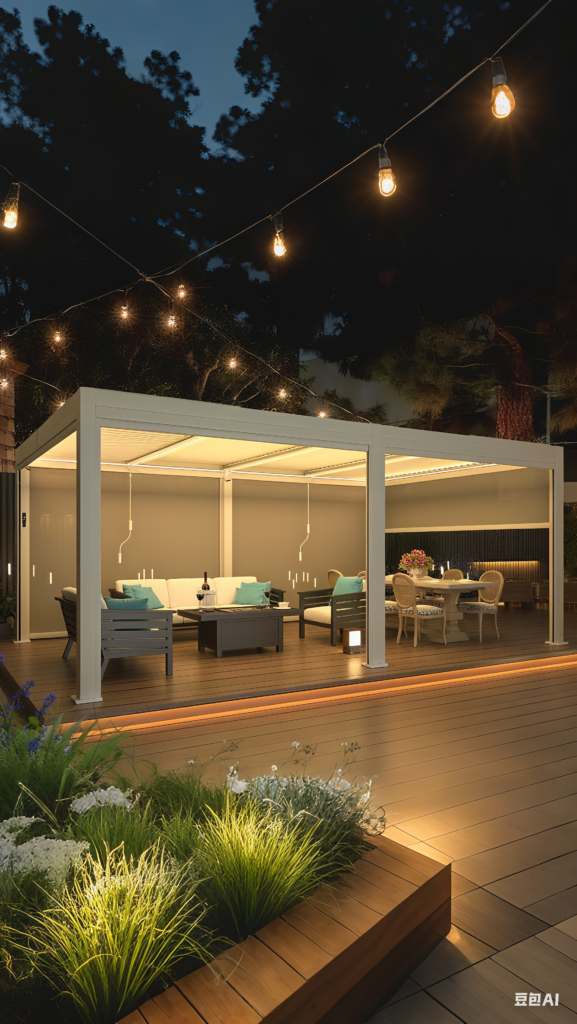
Many parking-structure pergolas incorporate louvered or slatted canopy elements. Buyers should verify that individual louvre retention methods prevent dislodgement under design wind pressures. Drip-edge detailing at periphery edges and provision for debris guard screening beneath the canopy are common project requirements that must be addressed in the shop-drawing phase.
Phase One — Documentation and Certification Checklist
Before any sample or drawing exchange, obtain the following evidence from every shortlisted supplier. This forms the baseline for commercial negotiation and technical approval.
- Material mill certificates for each aluminum alloy batch (6063-T5 / T6 as applicable)
- Third-party wind-load test report for the specific pergola profile system, including uplift pressure ratings and connection-zone verification
- Salt-spray or cyclic-corrosion test report matching the selected finish system
- CE certification documentation for market entry compliance where applicable
- ISO 9001 quality management system certificate
- SGS verification report confirming material composition and mechanical properties match stated alloy designation
- Fire-compliance statement referencing the applicable test standard; note that fire rating classification must be verified by a third-party report specific to the project jurisdiction
- EPD (Environmental Product Declaration) if the project requires embedded-carbon disclosure
| Document | What It Proves | Acceptance Criterion |
|---|---|---|
| Mill certificate | Alloy chemistry and temper condition | Matches spec sheet alloy (e.g., 6063-T5/T6) |
| Wind-load report | Structural capacity of profile and connections | Pressure rating ≥ project design uplift |
| Corrosion test report | Finish durability under aggressive exposure | Passes required hours per referenced standard |
| CE / ISO 9001 / SGS | Manufacturing quality and market compliance | Certificates current and scope covers pergola products |
| EPD | Life-cycle carbon data for sustainability targets | Verified under recognised EPD programme |
Phase Two — Sample Policy and Physical Evaluation
Never proceed to full production without evaluating physical samples against the project specification. A proper sample protocol protects both the buyer and the supplier from downstream disputes.
Sample types to request
- Profile cross-section sample: Show wall-thickness variation, corner radii, extrusion die-line quality, and milling surfaces for connection interfaces
- Finished-sample panel: Full-size section with applied finish, colour reference, and edge treatment representative of delivered product
- Connection-component sample: Brackets, clips, expansion-joint inserts, and fastener provisions so fit-check is possible before delivery
- Finishing cut-over sample: Demonstrates colour consistency across a production batch and edge-to-face transfer uniformity
Evaluation criteria for parking-structure samples
| Attribute | Test Method | Typical Acceptance Threshold |
|---|---|---|
| Surface colour match | Digital colourimeter against RAL / custom reference | ΔE ≤ 1.5 vs approved master |
| Coating adhesion | Cross-hatch pull-off per ASTM D3359 / ISO 2409 equivalent | Grade 4 or better |
| Film thickness | Magnetic or eddy-current gauge | Powder coat 60–80 µm; PVDF 25–30 µm; anodized 15–25 µm as specified |
| Profile dimensional check | CMM or calibrated optical comparator | Within drawing tolerance band |
| Gloss uniformity | 60° gloss meter | Consistent across face, edge, and milled area |
Sample sign-off procedure
The buyer should issue a formal sample-approval matrix listing each profile type, finish code, and dimension to be checked. Both parties sign the approved sample record. Any deviation noted during evaluation must be resolved before the supplier proceeds to bulk fabrication. Retain one copy as the project benchmark sample stored on-site or in a controlled archive.
Phase Three — Shop Drawing and CNC Capability Verification
Parking-structure pergolas typically feature long runs with repeated modules, variable column spacings, and integration points for lighting, solar-panel rails, and gutter channels. Shop drawings translate architectural intent into fabricator instructions. Buyers must confirm that the supplier’s CNC workflow can deliver parts within agreed tolerance bands.
Essential shop-drawing contents
- Full elevation and plan layouts showing pergola bay dimensions, column locations, and abutment details to existing structure
- Profile schedules with lengths, angles, and joinery notes for each member type
- Connection detail drawings showing bracket types, bolt grades, and adjustment allowances for site tolerances
- Expansion-joint placement schedule aligned with thermal movement calculations
- Drainage routing for any integrated gutter or downpipe provisions
- PV rail or ballast-point locations if the pergola supports photovoltaic modules
- Painting and marking schedule identifying which faces receive which finish system
Tolerance bands buyers should specify
| Feature | Typical Tolerance Band | Note |
|---|---|---|
| Overall bay length | ±2.0 mm per 3 m | Affects connection alignment to steel structure |
| Profile straightness | ±1.0 mm per metre run | Visible gap variation if exceeded |
| Slot and hole position | ±0.8 mm from drawing datum | Brackets and fasteners must seat without force-fitting |
| Angle-cut end treatments | ±0.5° | Critical for mitered junction appearance |
| Flatness of wide panels | ±1.5 mm over 3 m span | Lighting reflections amplify waviness |
CNC capability confirmation questions
During supplier qualification, ask whether the facility uses five-axis CNC machining centres for complex joinery, whether CAM programming is in-house or outsourced, and how they handle last-minute field-dimension changes. Confirm that they maintain a digital revision log so every shop-drawing iteration is traceable. Request a brief video walkthrough of their CNC setup as part of the pre-qualification pack.
Phase Four — Export Packing and Container Loading Protocol
Pergola components are long, lightweight extrusions that are vulnerable to edge damage and surface scoring during transit. Packaging errors cause现场现场 返工, which is far costlier than upfront packaging investment.
Packing requirements to include in the purchase order
- Each extrusion wrapped in protective polyethylene film with interleaf paper at contact points
- Corners protected with rigid cardboard or foam end caps
- Bundled lengths secured with plastic strapping spaced no more than 1.5 m apart
- Finished-components packed in separate cartons to prevent metal-to-metal abrasion
- Palletized shipments shrink-wrapped and labelled with bill-of-lading reference
Container sequencing best practice
Longer extrusions should be loaded first in the container, starting from the door end and working inward, so subsequent shorter modules nest behind them without handling damage. Heavier hardware crates go at the bottom; lighter trim and accessory boxes go on top. Include a loading plan sketch in the shipment documentation so the receiving team can verify container contents against the packed list before unloading begins.
Phase Five — After-Sales Documentation Handover
A clean handover at project close-out reduces maintenance costs and protects the buyer from warranty disputes later. Request the following package from the supplier before final payment release.
- As-built drawing set reflecting any site-modified dimensions recorded during installation
- Operations and maintenance manual covering cleaning agents, re-tightening schedules for expansion joints, and seasonal inspection checkpoints
- Spare-parts kit including spare brackets, sealants, and two extra profile lengths for future repair
- Finish-touch-up paint or powder touch-up material matched to the approved colour sample
- Digital photo record of critical connections taken during installation for future reference
- Warranty terms summary with scope, exclusions, and claim procedure clearly stated
| Deliverable | Format | When Required |
|---|---|---|
| As-built drawings | PDF + CAD source files | At substantial completion |
| O&M manual | Printed booklet + PDF | At handover |
| Spare-parts kit | Physical shipment | With final delivery |
| Photo record | High-resolution digital | During installation |
| Warranty summary | Signed document | Before final payment |
Frequently Asked Questions
What certifications should I ask an aluminum pergola supplier to provide?
Request CE, ISO 9001, and SGS documentation along with project-specific third-party reports for wind load, corrosion resistance, and fire compliance. Fire-rating classification must be confirmed by a third-party report matching the local code requirement for the project jurisdiction.
How do I evaluate a supplier’s CNC tolerance capability before ordering?
Ask for their CNC machine make and model, inquire whether CAM programming is handled in-house, review their standard tolerance bands against your project spec sheet, and request a sample lot with CMM measurement reports. A capable supplier will share these documents without hesitation.
Should I order a physical sample before approving production quantities?
Yes. Order at least one complete profile cross-section, one finished-panel sample with the exact specified finish, and one connection-component sample. Run colour, adhesion, film-thickness, and dimensional checks against your specification book and sign a formal sample-approval matrix before authorizing bulk fabrication.
What packing and container-loading requirements protect long extrusions during export?
Specify protective film wrapping, interleaf paper at contact points, rigid end caps, strategic strapping spacing, and palletized shrink-wrap for heavier components. Require a loading plan sketch so the supplier sequences long members first and separates finished parts from hardware to prevent surface scoring.
What after-sales documentation must a pergola supplier provide at project close-out?
Require as-built drawings, an operations and maintenance manual, a spare-parts kit with extra brackets and profile lengths, finish touch-up material, a digital photo record of critical connections, and a signed warranty summary. All items should be delivered before final payment is released.
Get in Touch
If you are procuring aluminum pergola systems for a parking-structure project and need clarification on certification requirements, sample policy, or tolerance handover, contact TOP METAL & TUORUNDA. Reach out to Jimmy via WhatsApp at +86-139-2919-8578 or email sales2@trdoutdoor.com to discuss your project specifications and request the supplier qualification pack.
Talk to Our Team
Planning a project or comparing suppliers? Send us your drawings, panel schedule or quantity list and we will come back with a specification proposal and a budget range for your review.
- Company: TOP METAL & TUORUNDA
- Contact: Jimmy
- WhatsApp: +86-139-2919-8578
- Email: sales2@trdoutdoor.com