What to Verify When Sourcing Perforated Aluminum Panels for Metro Station Projects
When evaluating a supplier of perforated aluminum panels for metro station orders, request evidence across six checkpoints: valid ISO 9001 / CE / SGS certification documents, third-party test reports for the specific fire-rating regime your jurisdiction requires, CNC perforation samples matching your target open-area ratio, a documented packing and container-loading procedure, a sample-delivery policy with turnaround times, and after-sales documentation covering shop-drawing support and installation guidance.

1. Certification Audit: What to Ask For and How to Verify It
Metro station procurement typically demands verified compliance rather than self-declared claims. Build your factory audit around three baseline certifications and one sustainability credential that increasingly appears in European and North American transit specifications.
Certification Documents to Request
- ISO 9001 — confirm the certificate is current, covers the manufacturing site in Foshan, Guangdong, China, and lists the product scope including perforated panels.
- CE — required for European projects; verify the Declaration of Performance references the correct EN standard and that the notified body number is legible.
- SGS — independent inspection records for material composition, coating thickness, and dimensional tolerance on representative batches.
Sustainability Credential
- EPD (Environmental Product Declaration) — available as an option for the AP series perforated panels. Confirm whether the EPD is product-specific and third-party verified, not a generic corporate statement.
Verification Method
Do not accept a certificate image alone. Cross-check the certificate number against the issuing body’s online registry. If the supplier cannot produce a live verification link, treat the claim as unverified.
2. Third-Party Test Reports: Fire, Acoustic, and Mechanical Performance
Metro stations carry distinct code requirements for surface materials. A competent buyer asks the factory to provide test reports matched to the exact product configuration — alloy, thickness, perforation pattern, and surface finish — rather than accepting a single report filed under a generic product name.
Fire Performance Verification
Fire rating requirements vary by jurisdiction. In Europe, the relevant framework typically references EN 13501-1 classification pathways; in North America, ASTM E84 or similar standards apply. Always request:
- A test report issued by an accredited laboratory for the specific panel assembly you intend to install.
- Confirmation of whether the reported fire performance applies to the core material, the coated surface, or the assembled system.
- Clear labeling of the test specimen — alloy grade (e.g., 6063-T5), panel thickness, powder-coat type, and open-area ratio must match your order specification.
Never proceed on the basis of a verbal claim. Any fire-compliance assertion must be backed by a third-party report that can be independently validated.
Acoustic Performance for Transit Environments
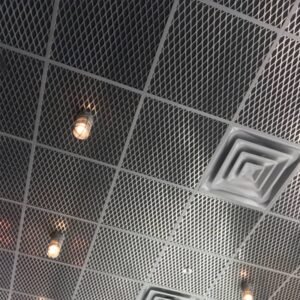
Metro concourses demand acoustic absorption. The perforated ceiling application offers a demonstrable NRC up to 0.85+ when configured with an appropriate absorptive backing such as foam or mineral wool. Request:
- An acoustic test report following ISO 354 or ASTM C423.
- Documentation showing the measured NRC at the specified perforation rate and backing material.
Mechanical and Coating Tests
- Coating adhesion cross-hatch test per ISO 2409 or equivalent.
- Powder-coat thickness confirmation within the 60–80 µm range for standard powder finishes.
- Anodized finish thickness within the 15–25 µm range where applicable.
- PVDF (Kynar 500) finish thickness within the 25–30 µm range for high-durability applications.
3. Factory Production Capability: CNC Precision and Quality Control
The perforation pattern on a metro station panel must hold tight tolerances across large facade or ceiling areas. A single inconsistent row is visually disruptive and may require field trimming that compromises structural integrity.
CNC Perforation Capability
During a factory visit or virtual audit, confirm the following:
- CNC punching or laser-cutting equipment capable of holding hole-position tolerance within ±0.5 mm over panel lengths up to 3,000 mm.
- Ability to produce variable open-area ratios from approximately 5% to 40%, adjustable per design requirement.
- Availability of radius-customization capability for curved-panel applications (AP200 series).
- Sample lead time and cost policy before committing to a full production run.
In-Process Quality Control
Ask the supplier to describe their inspection gates:
- Raw-material incoming inspection, including mill certificates for 6063 alloy verification.
- In-process dimension checks at the punching stage, with statistical sampling frequency.
- Final inspection reporting with coating thickness readings and visual acceptance criteria before packing.
4. Sample Policy and Shop-Drawing Review Process
A rigorous buyer evaluates how quickly and thoroughly a supplier can respond to a sample request and a set of shop drawings before production begins.
Sample Evaluation Criteria
- Physical sample with the exact alloy, finish, perforation pattern, and edge treatment called out in your drawing.
- Documented open-area ratio measurement performed on the actual sample, not a theoretical calculation.
- Coating thickness readings taken at multiple points across the sample panel.
- Photos of the sample mounted on a test frame to assess light transmission and visual effect at the intended viewing distance.
Shop-Drawing and Technical Coordination
Metro station穿孔板 usually interfaces with MEP penetrations, signage substrates, and acoustic backings. The supplier should demonstrate ability to:
- Review and mark up architect-issued shop drawings within an agreed timeframe.
- Provide detailed panel layout drawings including joint locations, access panels, and service cutouts.
- Coordinate with the main contractor on fixing-pattern compatibility with existing subframe systems.
5. Export Packing, Container Loading, and Shipping Documentation
Perforated panels are vulnerable to edge damage during transit, particularly when shipped long-distance from Foshan to ports in North America or Europe. Evaluate the supplier’s packing and loading discipline as part of your factory assessment.
Packing Standards to Specify
- Each bundle wrapped in waterproof VCI (volatile corrosion inhibitor) film to prevent salt-spray damage during sea freight.
- Corner protectors and edge guards on every panel stack to avoid deformation during handling.
- Plywood-free outer packaging or ISPM-15 compliant treated wood if wooden crating is used.
- Container-stuffing plan showing panel orientation, dunnage placement, and securing method to prevent movement.
Shipping Documentation Checklist
- Packing list with net weight, gross weight, and cubic volume per container.
- Commercial invoice with HS code alignment for your import customs broker.
- Certificate of origin, relevant for preferential tariff treatment where applicable.
- Third-party inspection report (SGS or equivalent) released prior to container sealing.
- Load-plan photographs uploaded before the container doors are sealed.
6. After-Sales Documentation and Installation Support
A responsible supplier provides structured post-order support because any defect discovered during installation can delay a live transit facility and trigger costly rework.
Documentation to Expect
- Detailed installation manual covering panel handling, storage, and fixing sequence.
- Fixing-pattern drawings compatible with common subframe systems used in transit construction.
- Surface-finish care and cleaning recommendations tailored to high-traffic environments.
- Warranty terms clearly distinguishing coverage for substrate, finish, and perforation integrity.
On-Site and Remote Support
Confirm whether the supplier offers:
- Video-guided installation sessions coordinated with your site engineering team.
- Response SLA for technical queries raised during the first week of installation.
- A spare-panel recommendation strategy based on normal fabrication yield loss plus a contingency percentage for transit damage.
Frequently Asked Questions
What certification documents should a buyer request before placing a metro station order?
Request current ISO 9001 and CE certificates covering the Foshan manufacturing site, SGS test reports for coating and mechanical properties, and an EPD if environmental declaration is required by the project specification. Verify each certificate through the issuing body’s public registry.
How do I confirm the fire-performance claim for perforated aluminum panels?
Fire rating requirements vary by jurisdiction, so insist on a third-party test report issued to an accredited laboratory for the exact panel configuration — alloy, thickness, perforation ratio, and finish. Never accept a generic claim without a validator-referencable report attached.
What tolerance should I specify for CNC-perforated panel hole positioning?
A typical requirement for transit-grade installations is ±0.5 mm hole-position tolerance over panel lengths up to 3,000 mm. Confirm this figure in writing and ask the factory to show a measurement log from recent production runs.
How should perforated panels be packed for ocean freight?
Specify VCI film wrapping, corner and edge protection on every bundle, ISPM-15 compliant or plywood-free outer packaging, and a documented container-stuffing plan with dunnage layout and load-securing method. Require photos before the container is sealed.
What after-sales documentation should the supplier provide with each shipment?
The supplier should deliver an installation manual, fixing-pattern drawings, surface-care guidelines, warranty terms aligned to product series and finish, and an agreed response timeline for technical questions raised during site installation.
Contact for Project Discussion
For factory audit scheduling, sample requests, or technical coordination on a metro station perforated-panel order, contact TOP METAL & TUORUNDA. Reach Jimmy via WhatsApp at +86-139-2919-8578 or email sales2@trdoutdoor.com.
Talk to Our Team
Planning a project or comparing suppliers? Send us your drawings, panel schedule or quantity list and we will come back with a specification proposal and a budget range for your review.
- Company: TOP METAL & TUORUNDA
- Contact: Jimmy
- WhatsApp: +86-139-2919-8578
- Email: sales2@trdoutdoor.com