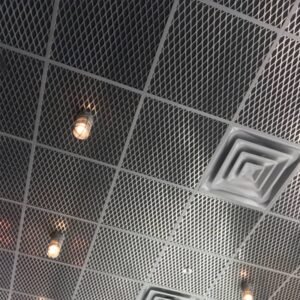
Clip-in aluminum ceiling tiles are purpose-built for data centers because they manage critical airflow, support efficient cooling, simplify maintenance access to overhead infrastructure, and meet the acoustic and durability demands of mission-critical environments.
Data centers operate under some of the most demanding environmental conditions in commercial construction. Every square meter of ceiling space must balance thermal management, airflow velocity, maintenance accessibility, fire safety compliance, and long-term material stability. Clip-in aluminum ceiling tiles have emerged as one of the preferred overhead solutions for this sector because they combine structural rigidity with engineered ventilation patterns that align directly with data center HVAC design philosophy.
Thank you for reading this post, don't forget to subscribe!The approach used by FstopMetal integrates perforated panel engineering, modular clip-in installation, and表面处理 options selected specifically for the chemical and thermal profiles found inside server rooms and raised-floor data halls. The result is a ceiling system that supports consistent airflow distribution while maintaining a clean, maintainable interior envelope.

Airflow Management and Cooling Efficiency
Cooling efficiency is the single most important performance driver in data center design. Hot aisles and cold aisles depend on predictable airflow paths, and the ceiling above those pathways plays a decisive role in mixing, containment, and pressure balancing. Clip-in aluminum ceiling tiles address this need through controlled perforation patterns that allow conditioned air to move vertically while minimizing turbulence that could disrupt cold-aisle containment strategies.
| Airflow Consideration | How Clip-in Aluminum Tiles Address It |
|---|---|
| Cold aisle containment integrity | Perforated panels positioned above hot aisles permit exhaust rise without disrupting sealed cold zones below |
| Air mixing and stratification | Engineered hole patterns reduce sudden pressure drops that can cause unwanted air recirculation |
| Raised-floor plenum utilization | Compatible with standard T-grid and concealed clip systems commonly used in data center flooring layouts |
| HVAC return path optimization | Openings can be sized and spaced to match return-air grille locations and reduce fan energy consumption |
| Dust and particulate flow | Aluminum surfaces resist buildup; perforations do not trap fibers like fibrous acoustic materials can |
Because the tiles are manufactured from 6063 aluminum alloy, the panel stiffness remains high even at thinner gauges. This allows designers to maximize open area ratio without sacrificing dimensional stability—a requirement when large ceiling spans cross above dense rack rows.
Thermal Performance and Heat Dissipation
Data centers generate continuous waste heat, and the ceiling layer sits between that heat source and the building envelope. Aluminum as a material has inherently favorable thermal conductivity compared to steel or composite alternatives, which means clip-in aluminum ceiling tiles contribute passively to heat redistribution rather than acting as insulating barriers.
In practice, this characteristic supports two common data center strategies:
- Hot-aisle containment: Perforated aluminum tiles above heated return paths allow warm air to escape upward toward ceiling-level return ducts without creating thermal pockets beneath solid panels.
- Ceiling plenum cooling: When conditioned supply air is distributed above the suspended ceiling, perforated aluminum allows controlled downward diffusion into working zones without short-circuiting the cooling loop.
The surface finish also matters. Powder-coated or PVDF-finished aluminum tiles retain their reflective properties over time, which helps manage radiant heat gain in facilities where ceiling plenums run hot. Surface durability under thermal cycling is essential because repeated heating and cooling can cause warping or fastener fatigue in lower-grade materials.

Acoustic Control in Mission-Critical Spaces
Server rooms and data center operations floors produce persistent broadband noise from cooling fans, UPS systems, and airflow turbulence. While acoustic comfort is secondary to equipment reliability, excessive noise creates operational challenges for facility staff and can exceed occupational exposure thresholds during extended maintenance windows.
FstopMetal’s perforated aluminum ceiling options support NRC ratings up to 0.85+ when paired with appropriate backing materials such as foam or mineral wool infill. This level of sound absorption is significant for data centers because it addresses both operator comfort and the clarity of alarm systems, intercoms, and equipment fault indicators.
| Acoustic Need | Tile Configuration Solution |
|---|---|
| High ambient equipment noise | Perforated aluminum with acoustic backing achieves NRC 0.85+ |
| Alarm audibility | Selective perforation patterns preserve speaker frequency transmission where needed |
| Background hum reduction | Dense infill behind perforated faces dampens low-frequency resonance |
| Cleanability vs. acoustic retention | Sealed membrane-backed panels maintain NRC while resisting contamination more effectively than exposed fibrous batts |
Maintenance Access and Modular Replacement
Data centers require frequent access to overhead infrastructure: fiber routing, power distribution units, VAV boxes, fire suppression piping, and sensor arrays all occupy the ceiling plenum. A ceiling system that complicates access increases downtime risk and labor cost.
Clip-in aluminum ceiling tiles are engineered for rapid individual panel removal and reinstallation without disturbing adjacent fields. This modularity offers several operational advantages:
- Targeted access: Technicians can lift a single tile to reach a specific conduit run or sensor without dismantling an entire ceiling section.
- Reusability: Aluminum clips and fasteners maintain tension over repeated cycles, unlike compressed-fiber tiles that degrade after removal.
- Contamination control: Unlike fiberglass-based acoustic tiles, aluminum panels do not shed fibers into server intakes when handled or replaced.
- Inspection visibility: Smooth, reflective surfaces make it easier to spot condensation, dust accumulation, or leaking piping during routine plenum checks.
The system is compatible with standard grid layouts used in commercial and industrial ceilings, meaning existing maintenance workflows and tool sets translate directly to data center installations.
Sustainability and Environmental Product Declaration Compliance
Modern data center projects increasingly require documented environmental performance, particularly for facilities targeting Green Globes, LEED, or corporate ESG reporting. FstopMetal offers EPD-certified aluminum cladding and ceiling solutions, providing verifiable lifecycle data that procurement teams and sustainability consultants can reference during specification review.
Key sustainability attributes relevant to data center specifications include:
- Recycled content: Aluminum products can incorporate up to 75% recycled aluminum, reducing virgin material demand without compromising mechanical performance.
- End-of-life recyclability: Aluminum is 100% recyclable without degradation of material properties, supporting circular-economy commitments in large-scale buildouts.
- Operational energy impact: Properly specified perforated ceiling systems improve airflow efficiency, which can reduce conditioning fan loads over the facility lifespan.
- Low-VOC surface finishes: Powder coating and PVDF applications emit minimal volatile organic compounds, supporting indoor air quality targets during and after commissioning.
Typical Data Center Application Zones
Clip-in aluminum ceiling tiles are not limited to a single zone within a data center. Different areas present different performance requirements, and FstopMetal product series can be matched accordingly:
| Data Center Zone | Recommended Tile Approach | Primary Performance Driver |
|---|---|---|
| Main server hall | Perforated AP-series panels with acoustic backing | Airflow management and noise reduction |
| Raised-floor corridor | Higher open-area-percentage perforations | Cold-aisle containment compatibility |
| UPS and battery room | Durable powder-coated or PVDF-finished panels | Corrosion resistance and cleanability |
| Network and comms room | Standard perforated clip-in tiles | Accessibility and EMI-neutral material choice |
| Loading dock and staging | Heavy-gauge aluminum panels | Impact resistance during equipment movement |
| Operations control center | Lower-perforation or solid finished panels | Acoustic comfort for monitoring staff |
Specification and Compliance Considerations
When specifying clip-in aluminum ceiling tiles for data center projects, architects and engineers should evaluate several factors beyond aesthetics:
- Fire compliance: Fire rating requirements vary by jurisdiction. Products must be verified against local codes using third-party test reports before specification finalization.
- Substrate compatibility: Ensure the clip-in system matches the existing or planned suspension grid, particularly in retrofits where older T-bar layouts must accommodate newer aluminum panel dimensions.
- Surface finish selection: Powder coating, anodizing, and PVDF options each offer不同的 moisture and chemical resistance profiles. Selection should reflect humidity levels, cleaning chemical schedules, and plenum environment conditions.
- Acoustic backing integration: If NRC performance is specified, confirm that infill material is compatible with the perforation pattern and does not compromise airflow volume calculations.
FstopMetal operates from Foshan, Guangdong, China, and holds CE, SGS, and ISO 9001 certifications. Products are exported to 36+ countries and are available in standard and custom configurations including curved and honeycomb panel formats for complex geometries.
Frequently Asked Questions
What makes clip-in aluminum ceiling tiles suitable for data centers?
They combine controlled perforation for airflow management, high structural rigidity from 6063 aluminum alloy, easy individual panel replacement for maintenance access, and optional acoustic backing that reaches NRC 0.85+ — all without shedding fibers into sensitive server intake environments.
Can these tiles support cold-aisle containment strategies?
Yes. Perforated aluminum ceiling tiles positioned above hot aisles allow warm exhaust air to rise naturally while maintaining separation from contained cold-air pathways below. Panel open-area ratios should be coordinated with the HVAC designer to avoid disrupting containment pressure balances.
Do aluminum ceiling tiles affect fire safety compliance?
Aluminum itself is non-combustible, but fire rating classifications depend on the full assembly including backing materials, seals, and installation method. Fire rating requirements vary by jurisdiction and must be verified by a third-party report specific to the installed system before specification finalization.
Is EPD certification available for data center ceiling projects?
Yes. FstopMetal offers EPD-compliant aluminum ceiling and cladding products, providing documented environmental product declarations that can support sustainability reporting and green building certification submissions.
How do I request a quote or technical specification for a data center project?
Contact TOP METAL & TUORUNDA directly. Reach Jimmy via WhatsApp at +86-139-2919-8578 or email sales2@trdoutdoor.com. Project-specific configuration, perforation patterns, and finish selection will be confirmed based on your HVAC and structural requirements.
Talk to Our Team
Planning a project or comparing suppliers? Send us your drawings, panel schedule or quantity list and we will come back with a specification proposal and a budget range for your review.
- Company: TOP METAL & TUORUNDA
- Contact: Jimmy
- WhatsApp: +86-139-2919-8578
- Email: sales2@trdoutdoor.com