


Direct Answer
Aluminum baffle ceilings are generally the stronger choice for metro stations due to their superior moisture and impact resistance, lower maintenance needs, and better acoustic performance. Gypsum board can work in low-traffic interior zones where cost is the primary driver, but it lacks the durability and humidity tolerance that high-volume transit environments demand.
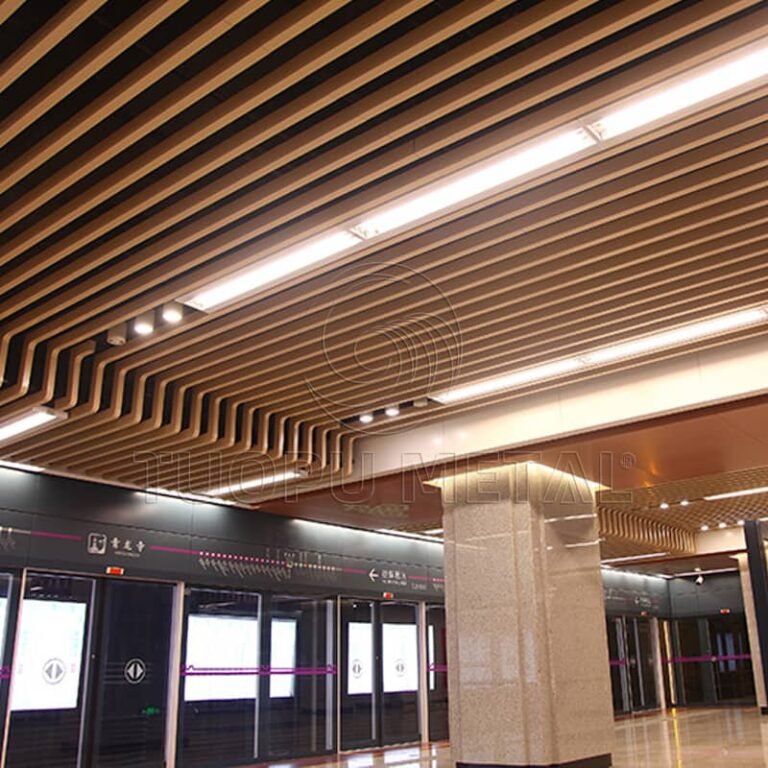
What Is an Aluminum Baffle Ceiling?
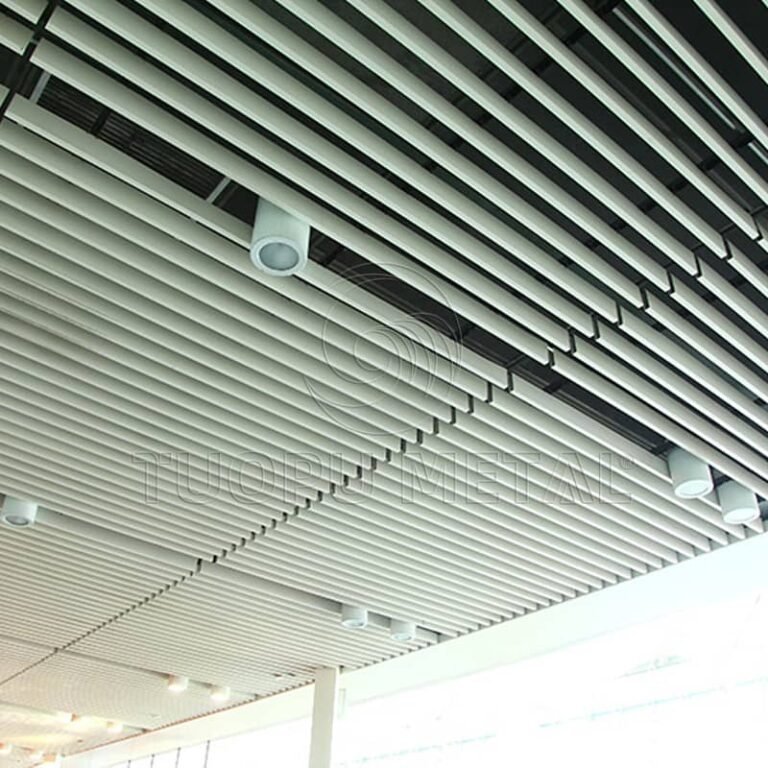
An aluminum baffle ceiling consists of elongated aluminum panels arranged in parallel lines, creating a linear, open-grid aesthetic. The system is available in several configurations — open baffle, closed baffle, and perforated variants — each offering different levels of light transmission, airflow, and acoustic treatment. Panels are typically fabricated from 6063-series aluminum alloy and can be finished with powder coating, anodizing, or PVDF (Kynar 500) depending on the environmental exposure and design intent.
FstopMetal offers baffle ceiling solutions as part of its metal ceiling system range, with options for custom geometries, honeycomb cores, and integrated acoustic backing. The modular nature of baffle systems allows easy access to overhead services — a practical advantage in metro stations where mechanical, electrical, and signaling infrastructure runs above the ceiling plane.
Key Characteristics
- Lightweight yet rigid — suitable for large-span installations without excessive support structure
- Modular design enables rapid installation and re-access
- Surface finishes are available in a wide color and texture range
- Perforated baffle options support acoustic absorption when paired with appropriate backing materials
- Recyclable content can be high, and EPD (Environmental Product Declaration) documentation is available for projects with sustainability targets
Gypsum Board Ceilings: Overview
Gypsum board — commonly known as drywall or plasterboard — remains one of the most widely used ceiling materials in commercial construction. It consists of a gypsum core sandwiched between paper facings, installed on metal or wood framing. In metro station applications, gypsum board is typically used in administrative areas, retail concourses, and low-traffic corridors rather than in high-moisture or high-impact zones.
The material is inexpensive and straightforward to install, but it has well-documented limitations in environments subject to humidity fluctuations, vibration, and physical impact — all of which are common in transit infrastructure.
Key Characteristics
- Low upfront material cost
- Simple installation by general contractors with standard tools
- Accepts paint finishes in any color
- Fire resistance is inherent to the gypsum core, though performance must be verified through project-specific third-party test reports
- Susceptible to moisture damage, sagging, and surface degradation in humid conditions
- Impact resistance is limited — denting and cracking are common in high-traffic settings
Head-to-Head Comparison for Metro Station Use
The following table summarizes the principal differences between aluminum baffle ceilings and gypsum board in the context of metro station construction and operation.
| Criterion | Aluminum Baffle Ceiling | Gypsum Board Ceiling |
|---|---|---|
| Moisture resistance | Excellent — impervious to humidity and condensation | Poor — core degrades when wet; not suitable for high-humidity zones |
| Impact resistance | High — tolerates accidental contact and cleaning equipment | Low — dents and cracks under moderate impact |
| Acoustic performance | Perforated baffles with acoustic backing can achieve NRC ratings of 0.85+ | Standard board offers minimal sound absorption; additional treatment required |
| Maintenance & access | Modular panels allow quick removal and reinstallation for service access | Once damaged, sections often require full replacement; access is destructive |
| Fire compliance | Fire rating requirements vary by jurisdiction; performance must be evidenced by a third-party test report | Gypsum core provides inherent fire resistance; rating depends on board type and assembly |
| Design flexibility | Linear, curved, and custom geometries; integrated lighting and ventilation options | Flat planes only; limited design variation |
| Lifespan in transit environments | Typical service life is significantly longer than gypsum in high-traffic, high-humidity conditions | Shorter effective lifespan where moisture, vibration, and impact are present |
| Recyclability | 100% recyclable at end of life; high recycled content available | Gypsum can be recycled but is rarely reclaimed in practice; paper facing complicates recycling |
| Installation speed | Faster for large areas due to modular clip-in system | Slower — requires taping, mudding, sanding, and painting |
| Typical cost profile | Higher initial cost; lower lifecycle cost due to durability and minimal maintenance | Lower initial cost; higher lifecycle cost from replacements and repairs |
Acoustic Considerations in Metro Stations
Metro stations are acoustically challenging environments. Announcements, train braking, crowd noise, and platform-edge reverberation all contribute to high ambient sound levels. Ceiling materials play a significant role in managing these conditions.
Aluminum baffle ceilings with perforated faces and acoustic backing — such as foam or mineral wool inserts — can achieve NRC (Noise Reduction Coefficient) ratings of 0.85 or higher. This level of absorption meaningfully reduces reverberation time and improves speech intelligibility for public address systems, a critical safety factor in transit environments.
Gypsum board, by contrast, is a reflective surface. Without additional acoustic treatment — such as suspended absorptive panels or baffles — a gypsum-ceilinged station will exhibit longer reverberation times and poorer acoustic comfort. This means that the apparent cost advantage of gypsum board can disappear once required acoustic upgrades are factored in.
Fire Safety and Code Compliance
Fire safety in metro stations is governed by jurisdiction-specific codes and performance-based requirements. Aluminum baffle ceilings, like all building products, must meet the fire rating requirements applicable to the project’s location. These requirements vary by jurisdiction and must be verified through a third-party test report rather than assumed from material category alone.
Gypsum board is often selected for its inherent fire-resistant core properties. However, the fire performance of any ceiling assembly — whether aluminum baffle or gypsum board — depends on the complete system construction, including substrates, fasteners, and any integrated services. Specifiers should request project-specific test documentation and confirm compliance with the applicable national or regional standard before finalizing material selection.
Neither material should be described as universally “non-combustible” or assigned a fire class without reference to a specific, project-verified test report. The responsible approach is to treat fire performance as a compliance question answered by documentation, not by material category alone.
When Gypsum Board May Still Be Appropriate
Despite the advantages of aluminum baffle ceilings, gypsum board remains a viable option in specific metro station applications:
- Administrative and staff-only areas with low foot traffic
- Enclosed mechanical rooms where aesthetic and acoustic performance are secondary
- Temporary or phased construction where budget constraints dominate
- Renovation projects where existing gypsum substrates are in acceptable condition
In these contexts, the lower upfront cost and ease of local contractor installation can outweigh the long-term performance benefits of aluminum. However, for passenger-facing platforms, concourses, and high-moisture zones, aluminum baffle systems are the more robust and cost-effective choice over the life of the facility.
Specification and Procurement Guidance
When specifying aluminum baffle ceilings for metro stations, the following parameters should be addressed early in the design process:
- Panel profile and spacing: Open vs. closed baffle, bay width, and visual density
- Finish system: Powder coating, anodizing, or PVDF — selected based on environmental exposure and aesthetic requirements
- Acoustic configuration: Perforation rate, backing material, and target NRC
- Service access: Location and frequency of overhead utilities to determine panel accessibility needs
- Fire documentation: Third-party test reports aligned with jurisdictional requirements
- Sustainability targets: EPD availability, recycled content, and end-of-life recyclability
FstopMetal, operating since 2003 and based in Foshan, Guangdong, China, supplies aluminum baffle ceiling systems to projects in 36+ countries. The company holds ISO 9001, CE, and SGS certifications. Custom designs, including honeycomb cores and 3D geometric patterns, are available through the engineering team.
Frequently Asked Questions
Can aluminum baffle ceilings meet metro station acoustic requirements?
Yes. Perforated aluminum baffle ceilings paired with acoustic backing materials can achieve NRC ratings of 0.85 or higher, making them suitable for the demanding acoustic environment of metro stations. The exact performance depends on perforation rate, backing material selection, and installation configuration.
Is aluminum baffle ceiling more expensive than gypsum board?
The initial material and installation cost of aluminum baffle ceilings is typically higher than gypsum board. However, when lifecycle costs — including maintenance, replacements, and acoustic treatment — are considered, aluminum often proves more economical, particularly in high-traffic, high-moisture transit environments.
Do aluminum baffle ceilings require special fire certification for metro use?
Fire rating requirements vary by jurisdiction. Aluminum baffle ceiling assemblies must be evaluated against the applicable local code, and performance must be evidenced by a third-party test report. Specifiers should request this documentation from the manufacturer before procurement.
Can aluminum baffle ceilings be customized for unique metro station designs?
Yes. Aluminum baffle systems offer significant design flexibility, including custom panel widths, spacing, curvature, color finishes, and integrated features such as lighting channels and ventilation openings. Honeycomb and 3D geometric configurations are also available for architecturally distinctive stations.
How does aluminum baffle ceiling maintenance compare to gypsum board in a metro station?
Aluminum baffle ceilings require minimal maintenance — periodic cleaning with standard methods is typically sufficient. Damaged panels can be individually removed and replaced without disrupting adjacent areas. Gypsum board, by contrast, often requires full section replacement when damaged, and repeated surface repairs can accumulate significant maintenance costs over time.
Talk to Our Team
Planning a project or comparing suppliers? Send us your drawings, panel schedule or quantity list and we will come back with a specification proposal and a budget range for your review.
- Company: TOP METAL & TUORUNDA
- Contact: Jimmy
- WhatsApp: +86-139-2919-8578
- Email: sales2@trdoutdoor.com