

Direct Answer
For school buildings, aluminum pergolas significantly outperform PVC in durability, fire safety, lifespan, and lifecycle cost. Aluminum pergolas offer 25 to 50 years of service life with zero maintenance, A2-class fire ratings, and up to 75 percent recycled content, while PVC degrades under UV exposure, lacks fire resistance, and typically requires replacement within 10 to 15 years. For high-traffic educational environments, aluminum is the technically and economically superior choice.
Why Material Choice Matters for School Pergolas
School buildings present demanding conditions for exterior architectural elements. Pergolas installed in playgrounds, courtyards, walkways, and sports areas endure heavy foot traffic, equipment impacts, frequent cleaning with harsh chemicals, and continuous UV exposure. The material selected must withstand these conditions without compromising student safety or requiring disruptive replacements during the academic year.
FstopMetal has manufactured aluminum pergolas since 2003, with product lines including the G100 Modern Cantilever Pergola, the G200 Traditional Pergola, and the G300 Motorized Pergola featuring intelligent rain-sensing louver control. Each series is engineered from 6063-T5/T6 aluminum alloy, a standard architectural-grade material chosen for its strength-to-weight ratio and corrosion resistance. The factory operates from a 15,000 m² facility in Foshan, Guangdong, China, and ships to more than 36 countries.
Aluminum Pergola vs PVC: Head-to-Head Comparison
The following table compares the two materials across the performance criteria that matter most in school environments.
| Performance Criterion | Aluminum Pergola | PVC Pergola | |
|---|---|---|---|
| Lifespan | 25 to 50 years | 10 to 15 years | |
| Fire Rating | A2-class non-combustible options available | Combustible; releases toxic fumes when burned | |
| Maintenance Requirement | Zero maintenance; powder-coated or anodized finish | Prone to cracking, yellowing, and warping; requires replacement | |
| UV Resistance | Superior; PVDF coatings rated for 30-year color retention | Degrades under prolonged UV exposure; becomes brittle | |
| Structural Strength | 6063-T5/T6 alloy; suitable for cantilever and large-span designs | Low structural capacity; cannot support heavy loads or wide spans | |
| Recycled Content | Up to 75 percent recycled aluminum | Minimal recycled content; not recyclable at end of life | Not recyclable |
| Full Lifecycle Cost | 30 percent lower than wrought iron over 25 years | Higher due to premature replacement and maintenance | |
| Acoustic Performance | Can be integrated with sound-absorbing ceiling systems (NRC 0.85+) | No acoustic integration capability | |
| Smart Integration | G300 series supports IoT sensors, solar panels, and automated louver control | Not compatible with smart building systems | |
| Coating Warranty | 25 to 30 years on powder coating; 20 years on anodizing | No meaningful warranty; finishes peel within 5 years |
Fire Safety: The Deciding Factor for Schools
Fire safety is the single most important differentiator between aluminum and PVC in educational facilities. Aluminum pergolas are available with A2-class fire ratings, meaning the material is non-combustible and will not contribute to fire spread. This is critical for school buildings, where fire codes are among the strictest in the building industry and where student safety regulations leave no room for compromise.
PVC, by contrast, is a petroleum-based plastic that melts, warps, and releases hydrochloric acid and other toxic gases when exposed to flame. Many school districts explicitly prohibit PVC in exterior installations near buildings for this reason. An aluminum pergola with A2 classification meets European fire safety standards and satisfies the requirements of most international building codes applicable to educational structures.
Durability Under School Conditions
School pergolas face unique wear patterns. Playground equipment impacts, backpack abrasion, cleaning chemical exposure, and seasonal temperature swings all accelerate material degradation. Aluminum’s powder-coated or anodized surface resists scratching, chemical attack, and UV breakdown. The G100 and G200 series from FstopMetal carry a 25-year coating warranty, and the G200 Traditional Pergola offers up to a 50-year structural warranty.
PVC pergolas typically show visible degradation within three to five years in direct sunlight. The material yellows, becomes brittle, and develops micro-cracks that expand under thermal cycling. In a school setting, where pergolas often serve as shaded walkways or courtyard covers, premature failure creates both a safety hazard and a disruptive replacement schedule that conflicts with the academic calendar.
Acoustic and Environmental Performance
Modern school design increasingly prioritizes acoustic comfort and sustainability credentials. Aluminum pergola systems can be integrated with perforated metal ceiling panels that achieve NRC ratings above 0.85, reducing noise reflection in outdoor courtyards and covered walkways. This is particularly valuable in school environments where noise control supports student concentration and teacher effectiveness.
From a sustainability standpoint, aluminum pergolas contain up to 75 percent recycled aluminum and are 100 percent recyclable at end of life. FstopMetal offers EPD-certified products and carbon-neutral options, which support schools pursuing green building certifications such as LEED or BREEAM. PVC lacks both recyclability and environmental product declarations, making it incompatible with sustainability mandates in public education procurement.
When PVC Might Still Be Considered
PVC pergolas are occasionally specified for low-budget, temporary, or purely decorative installations where structural loads, fire ratings, and longevity are not concerns. However, for permanent school installations—whether in courtyards, entry canopies, sports facilities, or outdoor classrooms—the technical and regulatory advantages of aluminum make PVC an unsuitable choice. The initial cost difference, if any, is quickly offset by aluminum’s longer service life and absence of replacement costs.
Design Options for School Aluminum Pergolas
FstopMetal offers three pergola series designed for different architectural and functional requirements in educational settings.
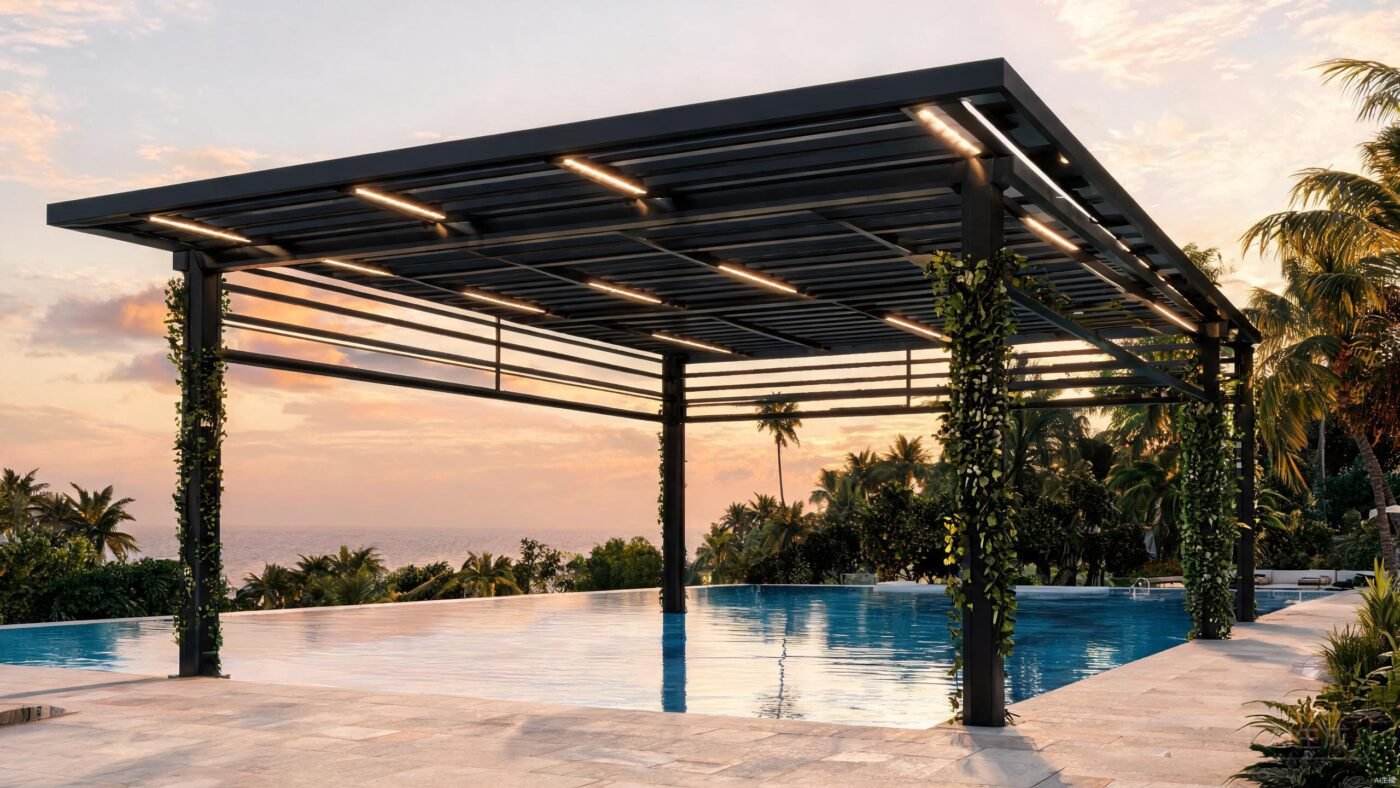
- G100 Modern Cantilever Pergola: Features a cantilever engineering design that eliminates central support columns, creating unobstructed space ideal for playgrounds and active areas. Biophilic design principles are incorporated. Rated for 25 years.
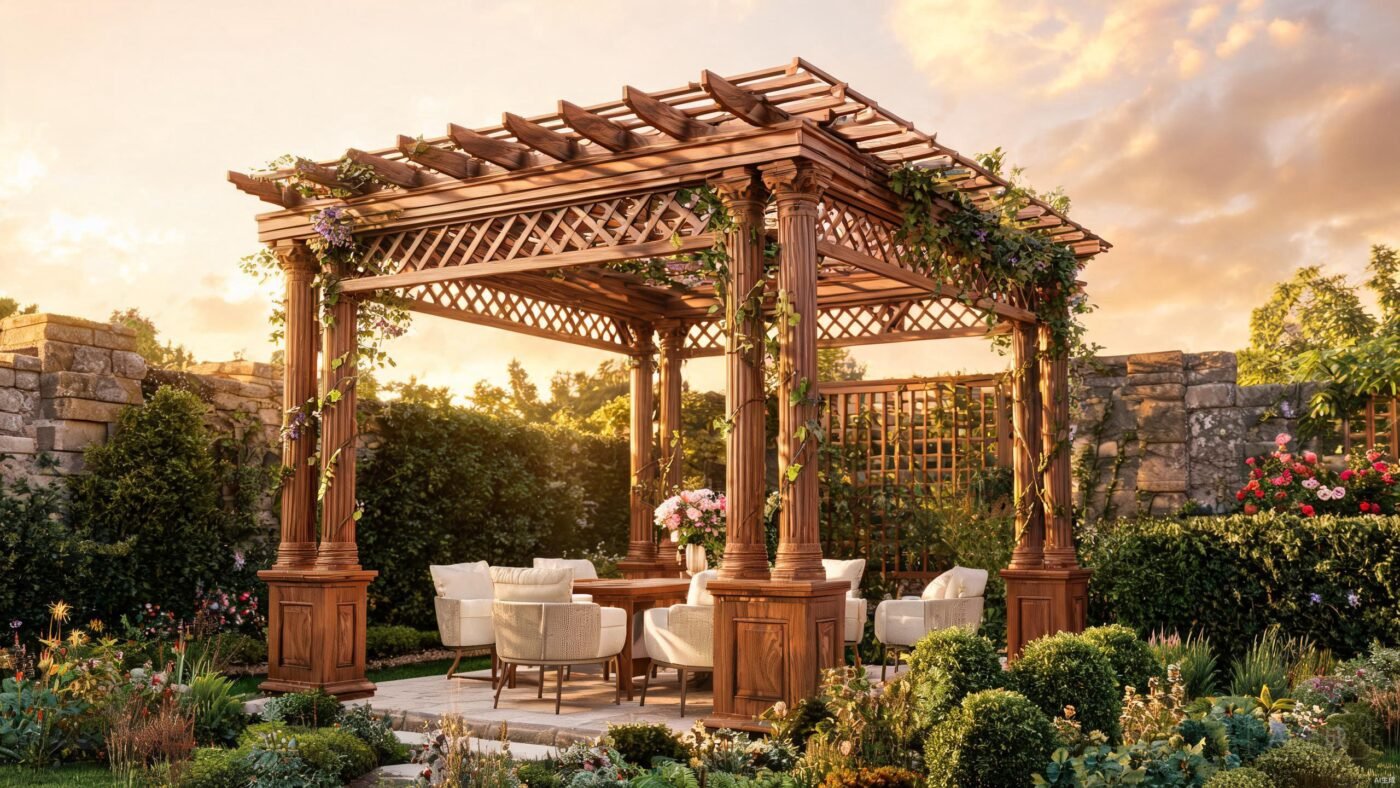
- G200 Traditional Pergola: Offers a classic aesthetic suitable for heritage-style school buildings or traditional campus architecture. Backed by a 50-year warranty. Available with integrated LED lighting and solar panel mounting interfaces.
- G300 Motorized Pergola: Equipped with intelligent rain-sensing technology and automatic louver adjustment. Compatible with solar power integration and smart building management systems. Rated for 25 years.
All series are manufactured from 6063-T5/T6 aluminum alloy and can be specified with powder coating, anodizing, PVDF coating, or wood grain finish. Custom designs including honeycomb and 3D geometric patterns are available through FstopMetal’s engineering team, which has over 20 years of custom manufacturing experience.
Frequently Asked Questions
What is the typical lifespan of an aluminum pergola installed at a school?
Aluminum pergolas from FstopMetal are rated for 25 to 50 years of service life depending on the series and coating specification. The G200 Traditional Pergola carries a 50-year structural warranty, while the G100 and G300 series carry 25-year warranties. This lifespan significantly exceeds that of PVC alternatives, which typically require replacement within 10 to 15 years.
Are aluminum pergolas fire-safe for use near school buildings?
Yes. FstopMetal aluminum pergolas are available with A2-class fire ratings, confirming the material is non-combustible. This meets the fire safety requirements of most international building codes and is a key advantage over PVC, which is combustible and releases toxic fumes when exposed to flame.
Can aluminum pergolas be integrated with smart building systems in schools?
Yes. The G300 Motorized Pergola series supports IoT integration including rain sensors, automated louver control, solar panel mounting, and LED lighting. These features align with smart campus initiatives and can be connected to existing building management systems.
What maintenance do aluminum pergolas require in a school environment?
Aluminum pergolas require zero maintenance. The powder-coated, anodized, or PVDF finishes resist corrosion, UV degradation, and chemical exposure from routine cleaning. This eliminates the disruption and cost associated with periodic repainting or part replacement that PVC installations demand.
Does FstopMetal provide EPD certification for aluminum pergola products?
Yes. FstopMetal offers EPD-certified products and carbon-neutral aluminum pergola systems, supporting schools and contractors pursuing green building certification credits. The aluminum used contains up to 75 percent recycled content and is 100 percent recyclable at end of life.