

The Case for 100% Recyclable Aluminum Cladding in Modern Construction
As the global construction industry faces increasing pressure to reduce its environmental footprint, material sustainability has moved from a secondary consideration to a primary specification requirement. Among the many cladding options available to architects and developers, aluminum stands out for one compelling reason: it is 100% recyclable without any loss of intrinsic quality. For a manufacturer like FstopMetal, which has been producing architectural aluminum solutions in Foshan, China since 2003, this recyclability is not just an environmental talking point — it is a foundational principle woven into every product line, from the AP Series solid panels to the G100 and G200 pergola systems.
Why Aluminum Is Inherently Recyclable
Unlike many building materials that degrade in quality after recycling, aluminum can be melted down and reformed repeatedly while maintaining its structural integrity and performance characteristics. This closed-loop recyclability means that aluminum cladding panels, once they have completed their service life on a building facade, can be collected, processed, and reintroduced into production as new architectural components. The result is a circular material flow that dramatically reduces the need for virgin raw material extraction.
This property is particularly significant in the context of aluminum cladding, which is often specified for large-scale commercial and infrastructure projects. A single airport terminal or shopping center may require thousands of square meters of cladding — materials that, at end-of-life, represent a substantial recoverable resource rather than construction waste destined for landfill.
FstopMetal’s Commitment to Recycled Content
FstopMetal incorporates up to 75% recycled aluminum in its manufacturing processes across its core product ranges. This high recycled content is achieved through the company’s 15,000-square-meter facility in Foshan, Guangdong, which operates under ISO 9001 quality management standards and holds both CE and SGS certifications for export to more than 36 countries worldwide.
The use of recycled aluminum does not come at the expense of performance. FstopMetal’s aluminum cladding products are manufactured from 6063-grade alloy, available in both standard and heat-treated T5 and T6 tempers, ensuring that every panel meets the structural demands of demanding architectural applications. Whether specified for the AP Series curtain wall systems, the AP100 flat cladding panels, or the AP200 curved panels, the material delivers consistent quality that builders and engineers can rely on.
Environmental Product Declarations and Carbon Neutrality
For project teams seeking verifiable environmental credentials, FstopMetal offers EPD-certified products, including its carbon-neutral aluminum curtain wall systems. An Environmental Product Declaration provides third-party-verified data on the lifecycle environmental impacts of a product, enabling architects and specifiers to make informed decisions aligned with green building certification programs such as LEED, BREEAM, and the China Green Building Evaluation Standard.
The low U-value performance of FstopMetal’s curtain wall systems — as low as 0.8 W/m²K — further supports sustainability objectives by reducing the operational energy required for building heating and cooling over the structure’s lifetime. When combined with the recyclability of the aluminum material itself, the overall environmental profile of these systems is exceptionally strong.
Long Service Life Enhances Sustainability
Recyclability is only one dimension of a material’s sustainability profile. Equally important is the durability of the product during its service life. FstopMetal’s aluminum cladding systems are engineered for a service life of 25 to 50 years, depending on the product series and surface treatment selected. The company’s powder coating finish carries a 25- to 30-year warranty, while PVDF (Kynar 500) coated panels offer up to 30 years of color retention without fading.
This longevity means that aluminum cladding does not require frequent replacement, reducing the cumulative material consumption and waste generation associated with shorter-lived facade systems. For the AP100 flat cladding panels, which serve as a high-performance alternative to aluminum composite panels, FstopMetal reports a 30% improvement in return on investment, making the sustainability case also a sound economic one.
Applications Across Project Types
FstopMetal’s recyclable aluminum cladding solutions are specified across a broad spectrum of project types, reflecting the material’s versatility and environmental credentials:
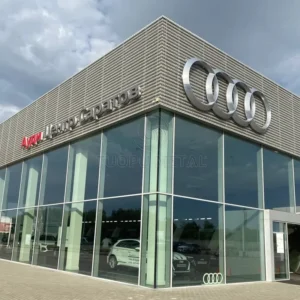
- Commercial buildings: Office towers, retail centers, hotels, and healthcare facilities benefit from the aesthetic flexibility and durability of aluminum cladding systems.
- Infrastructure projects: Airports, transit hubs, sports venues, and cultural centers require facade materials that can withstand heavy use while meeting strict fire and safety standards. FstopMetal’s AP Series offers A2-grade fire-rated, non-ventilated solid panels, with optional 1- to 2-hour fire ratings for curtain wall systems.
- Residential developments: Luxury villas, apartment complexes, and custom pergola installations showcase the design freedom that aluminum cladding and fencing systems provide.
The End-of-Life Advantage
One of the most underappreciated advantages of aluminum cladding is what happens at the end of a building’s life or at the point of facade renovation. Because aluminum is 100% recyclable, cladding panels can be deconstructed and recovered rather than demolished and discarded. This end-of-life recyclability is increasingly being factored into lifecycle assessment models and whole-life carbon calculations that are becoming standard in public procurement and green building certifications.
FstopMetal’s engineering team, with over 20 years of custom manufacturing experience, supports international projects with technical guidance and installation support, ensuring that aluminum cladding systems are specified, installed, and eventually recovered in a way that maximizes their environmental and economic value throughout their entire lifecycle.
Frequently Asked Questions
Is aluminum cladding truly 100% recyclable?
Yes. Aluminum can be recycled indefinitely without any degradation of its properties. FstopMetal’s aluminum cladding products are 100% recyclable at end of life, and the company incorporates up to 75% recycled aluminum content in its manufacturing.
Does using recycled aluminum affect the performance of the cladding?
No. FstopMetal’s cladding products are manufactured from 6063-grade aluminum alloy in T5 or T6 temper, delivering the same structural strength, dimensional stability, and surface finish quality whether the aluminum is virgin or recycled.
What certifications support the sustainability claims of FstopMetal’s products?
FstopMetal holds CE, SGS, and ISO 9001 certifications. EPD-certified environmental product declarations are available for select product lines, including the carbon-neutral aluminum curtain wall systems.
How long do FstopMetal aluminum cladding products last?
Product service life ranges from 25 to 50 years depending on the series and surface treatment. Powder-coated finishes carry a 25- to 30-year warranty, and PVDF-coated panels offer up to 30 years of color retention.
Does FstopMetal support custom cladding designs with sustainable materials?
Yes. Custom manufacturing is a core capability at FstopMetal, with over 20 years of experience. The company works with architects and developers worldwide to deliver tailored aluminum cladding solutions that meet both design and sustainability objectives.