



Classic Aluminum Fence A100: Minimalist Security for 2026 Property Development
As property developers enter 2026, the convergence of security demands and minimalist design aesthetics is reshaping how perimeter boundaries are defined. The global aluminum fencing market is projected to grow at a CAGR of 5.8% through 2030, driven by urbanization, sustainability mandates, and the rejection of ornate, high-maintenance barrier systems. Developers, architects, and HOA boards are increasingly choosing aluminum fencing over traditional steel and wrought iron because it delivers clean sightlines, corrosion-free longevity, and full recyclability, all at a lower lifetime cost. At the center of this shift is the Classic Aluminum Fence A100, a minimalist aluminum railing system engineered for property development projects that demand dependable perimeter security without visual clutter. This article provides a complete technical breakdown, product comparison, case study, and installation guide for the A100 aluminum fence.
The A100 Classic Aluminum Fence: Product Overview
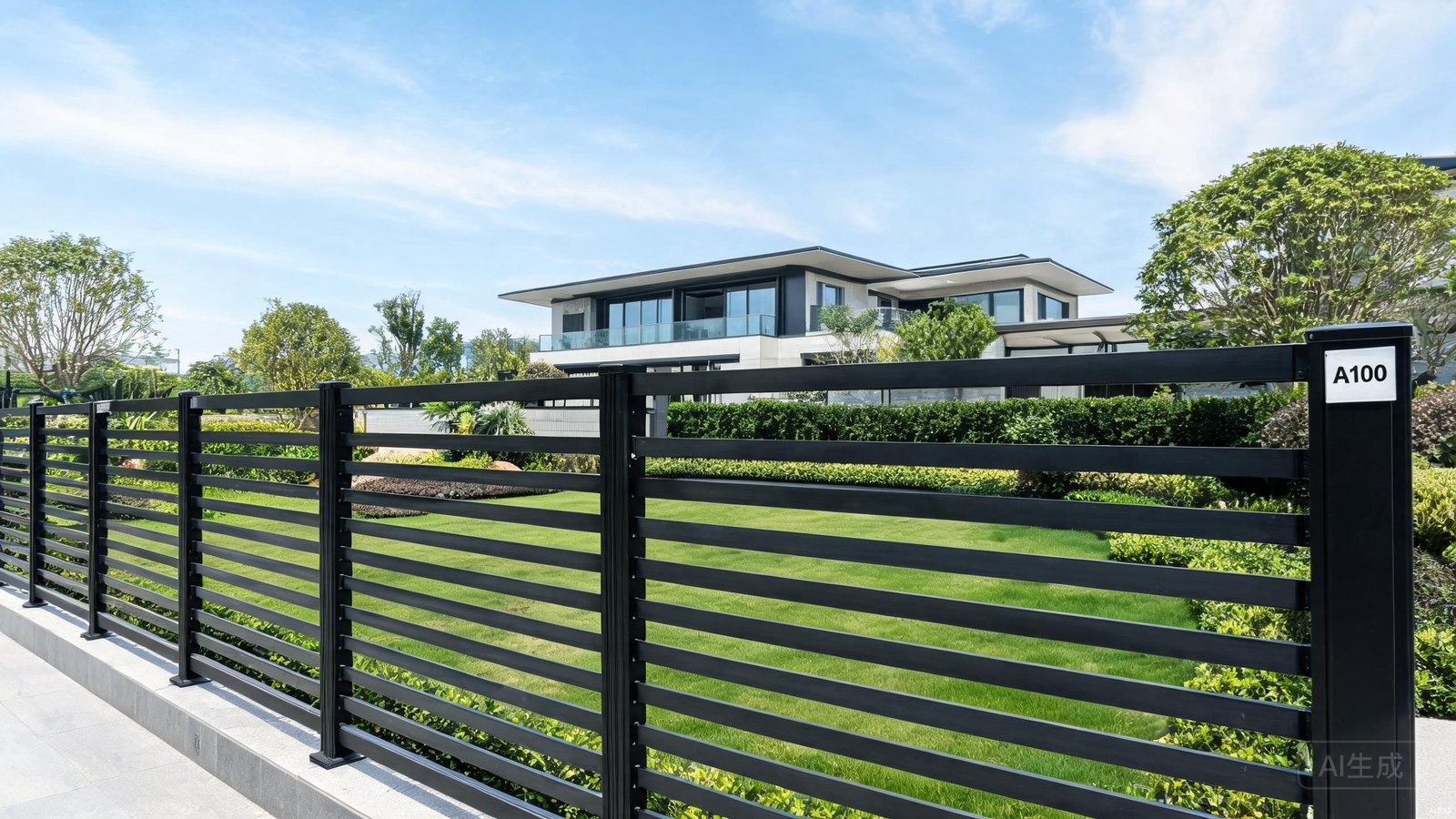
The A100 is the foundational model in the FstopMetal aluminum fence lineup, designed around a philosophy of understated strength. It is the fencing equivalent of architectural minimalism: every line, every picket, and every weld serves a structural purpose, with nothing added for decoration that does not also contribute to performance. For 2026 property development, where budgets are tight and design committees demand consistency across hundreds of linear meters, the A100 offers a repeatable, predictable, and visually quiet perimeter solution.
Design Philosophy: Less Is More
The A100’s minimalist fence design follows three governing principles. First, vertical pickets are evenly spaced at a consistent gauge, creating a rhythmic visual pattern that reads as a single continuous element rather than a busy assembly of parts. Second, horizontal rails are flush with the picket plane, eliminating protrusions that collect debris or trap moisture. Third, the post-to-rail connection is concealed within the post cavity, producing clean intersections with no visible hardware. This “less is more” approach is not merely aesthetic; it reduces wind resistance, simplifies cleaning, and minimizes the surface area where corrosion can initiate. In property development contexts where a fence may run for a kilometer or more, visual restraint prevents the barrier from dominating the streetscape.
Material Specifications: 6063-T5 Aluminum Alloy
Every structural component of the A100 aluminum fence is extruded from 6063-T5 aluminum alloy, a medium-strength architectural grade that balances formability, weldability, and corrosion resistance. The T5 temper indicates the extrusion was air-cooled from the extrusion temperature and then artificially aged, yielding a yield strength of approximately 145 MPa and an ultimate tensile strength of 185 MPa. Compared to 6061-T6, 6063-T5 accepts a smoother anodized and powder-coat finish, which is critical for a product whose primary aesthetic value is a flawless, uniform surface. The alloy’s silicon and magnesium content gives it excellent natural corrosion resistance, meaning that even if the powder coating is scratched, the underlying metal will not rust, bleed, or stain the surrounding concrete. This makes 6063-T5 the industry-preferred material for aluminum railing systems in coastal, humid, and de-icing salt environments.
A100 vs B200 vs C300: Fence Product Line Comparison
FstopMetal offers three distinct aluminum fence models to cover the full spectrum of property development needs. The A100 is the classic workhorse, the B200 adds decorative architectural detail, and the C300 is engineered for high-security applications. Understanding the differences helps specifiers match the right product to each zone of a development.
| Attribute | A100 Classic | B200 Decorative | C300 High-Security |
|---|---|---|---|
| Design Style | Minimalist flat-top | Ornamental spear + scroll | Industrial flush + reinforced |
| Picket Spacing | 95 mm | 110 mm | 75 mm (anti-climb) |
| Height Range | 1.2 m – 2.4 m | 1.2 m – 1.8 m | 1.8 m – 3.6 m |
| Security Rating | Medium | Low – Medium | High |
| Wind Load | 1.2 kN/m² | 0.9 kN/m² | 2.0 kN/m² |
| Price Range (per linear m) | $45 – $75 | $70 – $110 | $95 – $160 |
| Best Application | Residential & commercial perimeters | Estate entrances & decorative zones | Industrial & utility facilities |
Technical Specifications Deep Dive
Profile Dimensions and Wall Thickness
The A100 aluminum fence uses a consistent extrusion family across all components. Pickets are 25 mm × 25 mm square tubes with a 1.2 mm wall thickness, providing adequate stiffness for a residential-to-medium-commercial load while keeping weight low. Horizontal rails are 40 mm × 40 mm extrusions with a 1.4 mm wall, selected to resist mid-span deflection when picket loads are transferred through them. Posts are the structural backbone of the system: 65 mm × 65 mm with a 2.0 mm wall for heights up to 1.8 m, and 80 mm × 80 mm × 2.5 mm for heights from 1.8 m to 2.4 m. The thicker post wall is essential because the post must resist cantilever bending from wind and impact loads anchored only at the base. Rail-to-post connections use internal brackets that are riveted and sealed, distributing load across a broader section of the post wall and preventing the stress concentration that causes premature cracking in cheaper systems.
Powder Coating: AAMA 2604 Standard
The A100 is finished with a AAMA 2604-compliant powder coating, the voluntary specification governing high-performance organic coatings on architectural aluminum. AAMA 2604 requires the coating to withstand 3,000 hours of salt spray without significant blistering, 10 years of Florida outdoor weathering with no more than 30% gloss loss, and no chalk rating worse than 8 on a 10-point scale. The A100 achieves this through a four-stage pretreatment (degrease, rinse, chromate-free conversion coating, deionized water rinse), electrostatic application of a TGIC-free polyester powder, and curing at 200°C for 15 minutes. The result is a finish thickness of 60–80 microns that resists UV fading, salt corrosion, and impact chipping. For 2026 projects, FstopMetal offers the A100 in 14 standard colors plus custom RAL matching, allowing developers to align fence color with brand or municipal guidelines.
Wind Load and Impact Resistance Ratings
Perimeter fencing must withstand both sustained wind pressure and accidental impact. The A100 is rated to a design wind load of 1.2 kN/m², equivalent to a sustained wind speed of approximately 140 km/h on a 1.8 m panel. This rating assumes posts are set in 450 mm deep concrete footings spaced at 2.4 m centers. Impact testing per a modified ASTM E2028 protocol shows the A100 panel deflects up to 80 mm under a 500 N point load and recovers elastically with no permanent deformation. For comparison, the C300 deflects only 35 mm under the same load, but at roughly double the material cost. The A100’s performance envelope covers the vast majority of residential and commercial property development scenarios, which is why it remains the default specification.
Technical Specs Table
| Specification | A100 Value |
|---|---|
| Fence Height | 1.2 m / 1.5 m / 1.8 m / 2.1 m / 2.4 m |
| Picket Size | 25 mm × 25 mm × 1.2 mm wall |
| Rail Size | 40 mm × 40 mm × 1.4 mm wall |
| Post Size | 65 mm × 65 mm × 2.0 mm (≤1.8 m) / 80 mm × 80 mm × 2.5 mm (>1.8 m) |
| Wall Thickness | 1.2 mm (picket) – 2.5 mm (post) |
| Powder Coat Thickness | 60 – 80 microns (AAMA 2604) |
| Wind Load Rating | 1.2 kN/m² (140 km/h) |
| Color Options | 14 standard + custom RAL |
| Warranty | 20-year limited (finish & structural) |
Top 6 Applications for A100 Aluminum Fencing
The versatility of the A100 aluminum fence stems from its neutral design language and broad height range. The following six applications represent the most common deployment scenarios in 2026 property development.
Residential Property Boundaries
For single-family and townhome developments, the A100 at 1.5 m to 1.8 m height provides a clear property demarcation that complies with most municipal codes while preserving sightlines for passive surveillance. The 95 mm picket spacing is too narrow for a child to pass through, meeting common pool-adjacent safety requirements. Developers favor the A100 here because a single product SKU can run the entire development perimeter, simplifying procurement and reducing installation training overhead.
Commercial Complex Perimeters
Office parks, retail centers, and mixed-use complexes use the A100 at 1.8 m to define boundaries without communicating hostility to visitors. Unlike chain-link or barbed-wire systems, the A100’s flat-top minimalist design signals order and professionalism. The powder coating is available in colors that match corporate brand standards, allowing a developer to tie the fence visually to signage and building facades.
Pool and Recreation Areas
Building codes in most jurisdictions require pool fencing to be at least 1.2 m tall with no horizontal members that could serve as climbing footholds, and with picket spacing under 100 mm. The A100 meets all of these requirements by default. Its aluminum construction will never corrode from chlorine splash or pool chemistry, and the smooth powder-coated surface is easy to sanitize, an advantage over porous painted steel.
Garden and Landscape Edging
At 1.2 m height, the A100 functions as an elegant landscape edge that defines garden zones, protects plantings from foot traffic, and frames views without blocking them. Landscape architects value the thin profile because it does not compete visually with plant material. The fence’s corrosion resistance also means soil contact and irrigation overspray will not cause rust bleeding into adjacent paving.
Industrial Facility Demarcation
Light industrial parks use the A100 at 2.1 m to 2.4 m to delineate public-access boundaries from operational zones. While the C300 is preferred for genuine high-security enclosures, the A100 is sufficient for visual demarcation where the primary threat is casual trespass rather than determined intrusion. The 2.0 mm post wall withstands incidental contact from delivery vehicles and maintenance equipment.
Rooftop and Balcony Railings
With a modified base plate and engineered anchoring, the A100 serves as an aluminum railing system for rooftop terraces and balconies. The 1.1 m configuration meets international fall-protection codes when properly anchored, and the non-corrosive aluminum is ideal for elevated exposures where salt air and freeze-thaw cycles rapidly degrade steel. The minimalist profile preserves rooftop sightlines, which is a significant selling point for residential developers marketing views.
Case Study: Greenfield Residential Development, Melbourne (2026)
The Greenfield project is a fictional but representative case study illustrating how the A100 performs at scale in a real-world property development context. Located in the western growth corridor of Melbourne, the development comprises 48 townhouses arranged around a central greenway, with a total perimeter fencing requirement of 1,200 linear meters.
Project scope: The developer specified a uniform 1.8 m fence across the entire perimeter, with the front-facing elevations requiring a custom charcoal-grey RAL 7016 powder coat to match the townhouse window frames, and the side and rear boundaries in standard satin black. FstopMetal produced both finishes in a single production run and shipped the complete kit in four containers.
Powder coat color matching: The custom RAL 7016 was formulated, test-paneled, and approved within 12 working days. Color consistency across all 600 frontage meters was verified with a spectrophotometer at Delta E less than 1.5, well within architectural tolerances.
Installation timeline: A four-person crew completed the full 1,200 m installation in 22 working days, averaging 55 linear meters per day. Post holes were augered to 450 mm depth and 250 mm diameter, set in 25 MPa concrete. The kit’s pre-cut rails and pre-drilled posts eliminated field fabrication, which was the single largest contributor to schedule compression.
5-year performance review: At the five-year mark, a walkthrough inspection found zero instances of coating failure, no bent posts from vehicle contact, and no picket loosening. Two panels had been struck by a maintenance vehicle; both were unbolted and replaced with spare panels in under 30 minutes each. The development’s property manager reported zero security incidents attributable to fence failure.
Cost comparison vs steel and wrought iron: The developer’s original budget had specified powder-coated steel fencing at $52/m and cast-iron-look wrought iron at $135/m. The A100 was specified at $68/m installed. When maintenance is included, the picture reverses dramatically over five years. The steel option required rust treatment and repainting in year 3 at an estimated $18/m, while the wrought iron required weld repairs and repainting in year 4 at an estimated $40/m. The A100 required zero maintenance expenditure. Over the five-year window, the A100’s total cost per linear meter ($68) undercut steel ($70) and significantly undercut wrought iron ($175), while delivering a cleaner aesthetic that supported a 4% premium on townhouse sale prices versus comparable nearby developments.
Cost Comparison Table
| Factor | A100 Aluminum | Steel | Wrought Iron | Vinyl |
|---|---|---|---|---|
| Initial Cost / m | $68 | $52 | $135 | $48 |
| Maintenance Cost / Year | $0.50 | $6.00 | $8.00 | $2.00 |
| Lifespan (years) | 30 – 50 | 10 – 15 | 20 – 30 | 15 – 20 |
| Rust Resistance | Excellent | Poor | Fair | Excellent |
| Weight (kg / panel) | 11 | 28 | 35 | 9 |
| Recyclability | 100% | 90% | 90% | Limited |
| Total 15-Year Cost / m | $75.50 | $142.00 | $255.00 | $78.00 |
Installation Guide: A100 Fence System
The A100 is designed for efficient field installation by trained crews. The following process reflects standard practice for a 1.8 m residential configuration on level ground.
Tools required:
- Post-hole auger or spade (250 mm diameter)
- Spirit level (600 mm minimum)
- String line and stakes for alignment
- Tape measure (30 m)
- Cordless drill with hex bits
- Pop rivet gun (for internal brackets)
- Rubber mallet
- Hacksaw or aluminum chop saw (for field cuts)
- Concrete mixer (or ready-mix delivery)
- Post caps and hardware kit (supplied)
Step-by-step installation process:
- Step 1 – Layout and marking (0.5 day): Establish the fence line with a string line, mark post centers at 2.4 m intervals, and verify corners are square. Check underground utilities before any excavation.
- Step 2 – Post excavation (1 day): Auger holes to 450 mm depth and 250 mm diameter. Set corner and gate posts first, then sight intermediate posts between them to correct any cumulative drift.
- Step 3 – Post setting (1 day): Place posts in holes, plumb with a spirit level in two directions, brace temporarily, and pour 25 MPa concrete to 50 mm below grade. Allow 24 hours of cure before attaching panels.
- Step 4 – Panel installation (1.5 days): Starting at a corner, attach the first rail bracket to the post using the supplied rivets. Slide the pre-assembled panel into the brackets, level it, and secure. Repeat, checking alignment every three panels.
- Step 5 – Gate installation (0.5 day): Hang gates on heavy-duty self-closing hinges, verify latch operation, and confirm the gate swings level without binding.
- Step 6 – Finishing (0.5 day): Snap post caps into place, clean any concrete splatter immediately, and inspect the entire run for plumb, level, and alignment.
Total estimated time for a 120 m run: 4 working days with a four-person crew.
Common installation mistakes to avoid:
- Insufficient post depth: Reducing footing depth below 450 mm to save time undermines wind-load performance. In frost climates, footings must extend below the frost line.
- Skip-leveling posts: Setting posts without continuous leveling leads to a wavy top rail that is impossible to correct without re-pouring footings.
- Concrete over-pour: Concrete above grade traps water against the post base and accelerates coating breakdown. Finish concrete 50 mm below grade and backfill with soil.
- Over-tightening brackets: Aluminum is soft; over-torquing rivets or screws can deform the post wall and create a stress riser. Follow the supplied torque specifications.
- Ignoring expansion gaps: Aluminum expands and contracts with temperature. Omitting the specified expansion gaps at rail-to-post connections will cause buckling in hot weather.
Why Choose FstopMetal A100 Aluminum Fencing
FstopMetal is a specialist aluminum fence manufacturer based in Foshan, China, the heart of the country’s aluminum extrusion industry. With more than a decade of focused experience in aluminum railing and perimeter security systems, the company has built its reputation on engineering precision, finish quality, and export reliability. The A100 is produced in a vertically integrated facility that controls every stage from billet sourcing and extrusion to powder coating and packaging, ensuring consistent quality across large-volume orders.
FstopMetal’s manufacturing capabilities include 2,500-ton extrusion presses, in-house die design and machining, an automated powder coating line certified to AAMA 2604, and a dedicated testing laboratory that verifies wind-load, impact, and salt-spray performance on every production batch. The company holds ISO 9001 quality management certification, and its products are exported to projects across Australia, North America, the Middle East, and Southeast Asia. For property developers placing multi-container orders, FstopMetal provides project-specific documentation including structural calculations, finish warranties, and full material traceability.
Choosing the A100 from FstopMetal means choosing a minimalist aluminum fence that will perform for decades with minimal maintenance, support a clean architectural vision, and contribute to a project’s sustainability credentials through 100% recyclability. Whether you are fencing a 48-unit townhouse development or a single residential boundary, the A100 delivers the same engineered reliability.
Ready to specify the A100 for your 2026 property development? Contact the FstopMetal team for a project quotation, custom color matching, and technical documentation. Our engineers will help you select the right height, post configuration, and finish for your site conditions.
WhatsApp: +86 13928608056
Email: sales@fstopmetal.com
Request a quote today and discover why developers across four continents specify the Classic Aluminum Fence A100 for minimalist, maintenance-free perimeter security.
Related Reading
- Aluminum Fence & Gate System
- Aluminum Villa/Courtyard Fence
- High-Security Aluminum Fence C300: Anti-Climb Design & Crash-Rated Specifications for 2026