


Introduction: The Energy-Generating Facade Revolution
Building-Integrated Photovoltaics (BIPV) aluminum curtain walls represent the most significant leap in sustainable architecture since the introduction of double-glazing. In 2026, global BIPV curtain wall installed capacity surpassed 4.8 GW, a 22.5% year-over-year increase, with aluminum-framed systems accounting for over 60% of new installations. As the European Union’s Carbon Border Adjustment Mechanism (CBAM) enters full enforcement and China’s mandatory ultra-low-energy building codes take effect, BIPV aluminum curtain walls have shifted from an experimental novelty to a mainstream specification for commercial towers, institutional buildings, and luxury residential developments.
This guide examines the technology, performance data, economics, and real-world case studies behind BIPV aluminum curtain wall systems—helping architects, developers, and contractors make informed decisions for 2026 projects.
What Is a BIPV Aluminum Curtain Wall?
A BIPV aluminum curtain wall integrates semi-transparent photovoltaic modules—typically thin-film cadmium telluride (CdTe) or crystalline silicon cells laminated between glass—into the aluminum framing system of a building’s facade. Unlike rooftop solar panels, BIPV modules serve a dual purpose: they function as the building’s weather barrier and architectural envelope while simultaneously generating electricity.
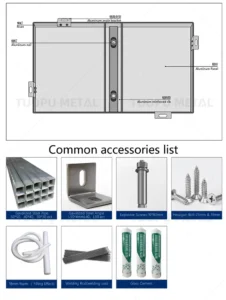
The aluminum curtain wall framing (typically 6063-T5 or 6063-T6 alloy) provides the structural support, weather sealing, and electrical conduit routing for the integrated PV system. The result is a facade that offsets 10-15% of a building’s operational energy consumption over its lifecycle, according to 2026 industry data.
Key Components of a BIPV Curtain Wall System
| Component | Material | Function |
|---|---|---|
| Aluminum Mullions | 6063-T5/T6, thermal-break | Structural support, PV cable routing |
| PV Glass Modules | CdTe thin-film or c-Si laminated | Electricity generation, daylighting |
| Insulated Glass Units | Low-E double/triple glazing | Thermal insulation, U-value control |
| Junction Boxes | IP68 rated, aluminum housing | Electrical connections, bypass diodes |
| Inverter System | Micro-inverters or string inverters | DC to AC conversion, grid synchronization |
| Weather Sealing | EPDM gaskets, silicone sealant | Air/water tightness, PV cable protection |
2026 Performance Specifications & Technical Data
Modern BIPV aluminum curtain walls deliver measurable performance across energy generation, thermal efficiency, and structural integrity. The following table summarizes 2026 benchmark specifications from leading manufacturers:
Energy Generation Performance
| Parameter | Standard BIPV | Premium BIPV | Next-Gen BIPV |
|---|---|---|---|
| Cell Type | CdTe thin-film | Mono c-Si | Perovskite tandem |
| Module Efficiency | 12-15% | 18-22% | 26-28% |
| Transparency | 10-30% | 5-20% | 15-40% |
| Power Density (W/m2) | 80-120 | 140-180 | 200-250 |
| Annual Yield (kWh/m2/yr) | 80-110 | 120-160 | 180-220 |
| Temperature Coefficient | -0.25%/C | -0.35%/C | -0.18%/C |
| Lifecycle (years) | 25 | 30 | 30+ |
Thermal & Structural Performance
| Parameter | Specification | Standard Reference |
|---|---|---|
| U-Value (W/m2.K) | 0.8-1.2 | EN 13830 (EU mandate 2026) |
| Solar Heat Gain Coefficient (SHGC) | 0.15-0.35 | Adjustable via PV density |
| Visible Light Transmittance (VLT) | 5-40% | Customizable per orientation |
| Air Infiltration | 0.05 m3/h.m max | EN 12153 Class A4 |
| Water Penetration | 600 Pa min | EN 12154 Class RE1200 |
| Wind Load Resistance | 2.4 kPa min | ASTM E330 |
| Fire Rating | Class A (non-combustible) | EN 13501-1 |
Economic Analysis: ROI & Payback Periods
The economics of BIPV aluminum curtain walls have improved dramatically. In 2026, the levelized cost of energy (LCOE) from BIPV facades ranges from $0.06 to $0.11 per kWh, competitive with grid electricity in most commercial markets. The table below outlines typical project economics:
| Metric | Office Tower (20,000 m2 facade) | Institutional Building (8,000 m2) | Luxury Residential (3,000 m2) |
|---|---|---|---|
| BIPV System Cost ($/m2) | $350-$480 | $380-$520 | $450-$650 |
| Annual Energy Generation (MWh) | 1,600-2,400 | 640-960 | 240-360 |
| Annual Energy Savings | $160K-$280K | $64K-$112K | $24K-$42K |
| Grid Export Revenue | $40K-$80K | $16K-$32K | $6K-$12K |
| Payback Period | 7-10 years | 8-11 years | 10-14 years |
| 25-Year Net Savings | $3.2M-$5.8M | $1.1M-$2.2M | $320K-$620K |
| CO2 Offset (tons/25yr) | 8,000-12,000 | 3,200-4,800 | 1,200-1,800 |
Application Scenarios
1. Commercial Office Towers
High-rise office buildings with large south- and west-facing facades are ideal candidates. A 2026 study of 15 BIPV-equipped office towers showed average energy self-sufficiency rates of 18-25%, with peak generation aligning with afternoon cooling loads. The aluminum curtain wall framing also enables modular factory pre-assembly, reducing installation time by up to 55% compared to stick-built systems.
2. Institutional & Educational Buildings
Universities, research centers, and government buildings increasingly mandate net-zero or near-net-zero performance. BIPV curtain walls help these projects achieve LEED Platinum or BREEAM Outstanding certifications, with aluminum framing contributing additional LEED points through high recycled content (31% average in 2026).
3. Mixed-Use & Luxury Residential
High-end residential developments use BIPV curtain walls for both energy generation and architectural distinction. Semi-transparent CdTe modules provide filtered daylight while maintaining privacy—a key selling point for premium units.
Case Study: Shenzhen Zero-Carbon Innovation Center
Completed in Q1 2026, the Shenzhen Zero-Carbon Innovation Center features a 12,000 m2 BIPV aluminum curtain wall using CdTe thin-film modules integrated into a unitized aluminum framing system.
| Metric | Result |
|---|---|
| Total Facade Area | 12,000 m2 |
| BIPV Module Count | 3,840 panels |
| Installed Capacity | 480 kWp |
| Annual Generation | 528,000 kWh |
| Building Energy Offset | 22.4% |
| U-Value Achieved | 0.82 W/m2.K |
| CO2 Reduction (annual) | 420 tons |
| System Cost | $4.6M |
| Estimated Payback | 8.7 years |
The project achieved China’s Near-Zero Energy Building certification and served as a CBAM-compliant export showcase for European clients.
CBAM Compliance & Carbon Accounting
For projects exporting to or operating within the EU, BIPV aluminum curtain walls offer a strategic CBAM advantage. The embedded carbon of aluminum curtain wall framing has dropped significantly with recycled content increasing to 31% in 2026 (target: 35% by 2030). Recycled aluminum requires only 5% of the energy needed for primary aluminum smelting, dramatically reducing the declared carbon footprint of the facade system.
Key CBAM documentation requirements for BIPV curtain walls include:
- Environmental Product Declaration (EPD) for aluminum profiles
- Carbon footprint certificate for PV modules
- Recycled content verification (third-party audited)
- Embodied carbon calculation per EN 15978
Installation & Integration Considerations
Successful BIPV curtain wall projects require coordination between facade contractors and electrical engineers. Key considerations include:
- Cable routing: PV interconnect cables must be routed within aluminum mullion cavities without compromising weather seals
- Inverter placement: Micro-inverters at each panel or string inverters at floor levels—each has tradeoffs in maintenance accessibility
- Thermal management: PV cells generate heat; adequate ventilation behind modules prevents efficiency degradation
- Maintenance access: BMU (building maintenance unit) compatibility for periodic panel cleaning and inspection
- Grid interconnection: Early engagement with utility companies for net-metering or feed-in tariff agreements
Future Outlook: Perovskite & Beyond
Perovskite-silicon tandem cells, achieving 26-28% efficiency in lab settings, are entering pilot production for BIPV applications in 2026-2027. These next-generation cells promise 40% higher power density than current CdTe modules, potentially reducing payback periods to under 6 years. Aluminum curtain wall manufacturers are already developing compatible framing profiles to accommodate the new module dimensions and electrical characteristics.
Conclusion
BIPV aluminum curtain walls represent the convergence of energy generation, architectural aesthetics, and regulatory compliance. With 4.8 GW of installed capacity globally and payback periods now under 10 years for commercial projects, the technology has crossed the threshold from innovation to standard practice. For developers and architects planning 2026-2028 projects, BIPV facades offer a compelling combination of energy savings, carbon reduction, and building certification advantages.
Ready to Start Your Project?
As a leading Foshan-based aluminum curtain wall and metal ceiling manufacturer, FstopMetal delivers factory-direct pricing, ISO-certified quality, and global shipping to 80+ countries.
- WhatsApp: +86 13928608056
- Email: info@fstopmetal.com
- Website: www.fstopmetal.com
Get a free quote within 24 hours. MOQ flexible. Custom OEM/ODM welcome.
Related Reading
- BIPV Solar Aluminum Curtain Wall: The 2026 Green Building Revolution
- Aluminum Curtain Wall Systems: Complete Specification Guide for Architects 2026
- Fire-Rated Aluminum Curtain Walls: 2026 Building Code Compliance Guide