
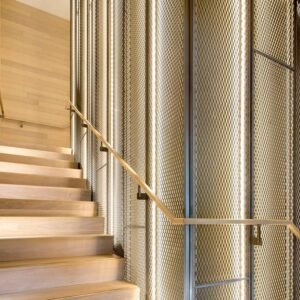
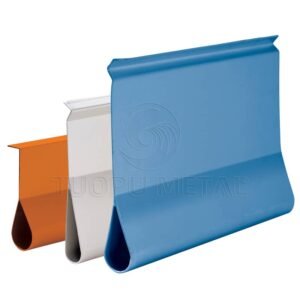
When procuring perforated aluminum panels for hospital corridors, buyers should confirm dimensional tolerances, perforation pattern consistency, finish thickness, acoustic backing specification, and fire-performance test reports before placing an order. The checklist below covers the verifiable documents and capabilities a manufacturing partner must evidence at each project stage.
Tolerance and Dimensional Verification for Hospital Corridor Panels
Hospital corridor environments impose tighter dimensional expectations than commercial retail or parking-structure cladding. Corridor panel runs must align at joints without visible gap variation, and perforation patterns must remain uniform across each sheet so that visual rhythm does not break when panels butt together at ceiling or wall transitions. Before committing to a supplier, request the following dimensional tolerances in writing:
- Panel length and width tolerance (typically expressed in millimetres relative to the nominal shop size)
- Perforation hole diameter and pitch tolerance, with the adjustable perforation rate the supplier can hold across a full order
- Edge-bend or hemming consistency, where applicable to the mounting method
- Flatness tolerance across the panel face to prevent oil-canning distortion in long corridor runs
FstopMetal’s AP300 perforated panel series supports adjustable perforation rates and is manufactured from 6063 or 6063-T5/T6 aluminium alloy, the standard building-grade and heat-treat-strengthened grades respectively. Ask the supplier to confirm which alloy temper will be used for your specific panel thickness and to provide a dimensional tolerance table that maps each tolerance to the applicable EN or ASTM standard referenced in the project specification.
Acoustic Backing and NRC Confirmation
Hospital corridors are high-footfall acoustic zones. The fact sheet lists NRC performance up to 0.85 or better when perforated panels are combined with an acoustic backing. Specify whether the project requires foam, mineral wool, or another infill material, and ask the supplier to confirm the composite NRC value for the exact panel thickness, perforation rate, backing material, and cavity depth you have designed. A standalone panel datasheet without the backing configuration does not constitute a usable acoustic specification.
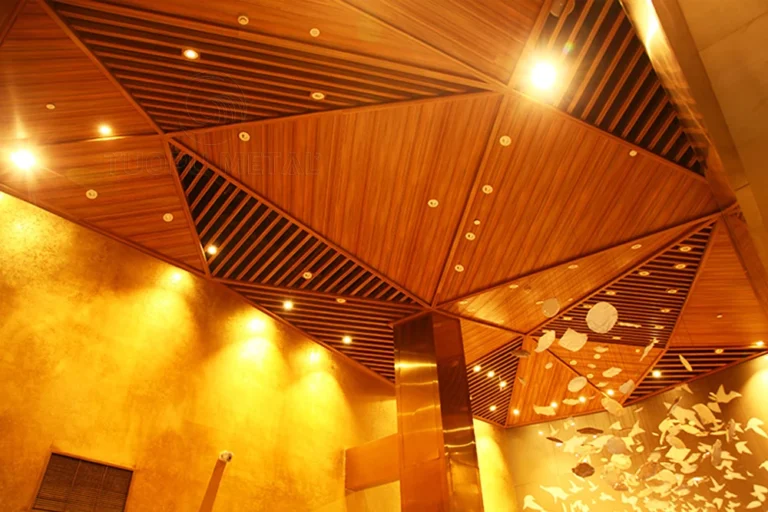
Certifications and Third-Party Test Reports to Request
For a hospital project in North America or Europe, the procurement file should reference quality and conformity documents that the supplier can produce on request. At a minimum, confirm that the manufacturing facility holds ISO 9001 (quality management), CE (European market conformity), and SGS (independent quality verification). Do not accept a certification name without seeing the current certificate issued by the relevant body.
Beyond factory-level certificates, hospital codes increasingly require product-level evidence:
- A third-party test report for fire performance. Fire rating requirements vary by jurisdiction and by building type; the applicable test standard and the classification result must be confirmed by the report, not by a marketing claim. Ask the supplier to state which test standard was used and whether the result covers the specific panel thickness, finish, and backing configuration in your design.
- An Environmental Product Declaration (EPD) if the project carries a green-building or net-zero embodied-carbon target. FstopMetal’s curtain-wall systems carry an EPD option with up to 75 % recycled aluminium content; ask whether the same EPD scope extends to the perforated panel line you are specifying.
- A material mill certificate (heat-treatment log, alloy designation, and batch traceability) for every delivery lot.
If the supplier cannot produce a third-party fire-performance report for the exact configuration you need, the panel cannot be installed in a jurisdiction that mandates one. Document this gap in the RFQ response and treat it as a disqualifying criterion.
CNC Capability, Shop Drawings, and Sample Policy
Custom perforation patterns, curved panel radii (as in the AP200 series), and non-standard panel sizes all depend on the supplier’s CNC and fabrication capability. Confirm the following before issuing a purchase order:
- Maximum panel dimension the shop can machine in one operation without splice joints
- Minimum perforation hole diameter and maximum perforation area the tooling can hold to tolerance
- Whether curved or compound-curved panels are produced in-house or by an outsourced partner
- Shop-drawing and CAD/BIM model review process: who issues the fabrication drawings, how many revision rounds are included, and who stamps them for installation
For hospital corridor projects, request a physical sample panel before bulk production. The sample should include the exact finish you specified—powder coating (60–80 µm), anodizing (15–25 µm), PVDF (25–30 µm), or wood-grain transfer—and the acoustic backing fitted. Evaluate the sample against your colour standard (RAL, Pantone, or project-specific), check the perforation pattern under corridor lighting, and verify edge finishing. Agree the sample approval in writing so it becomes the reference for the production batch.
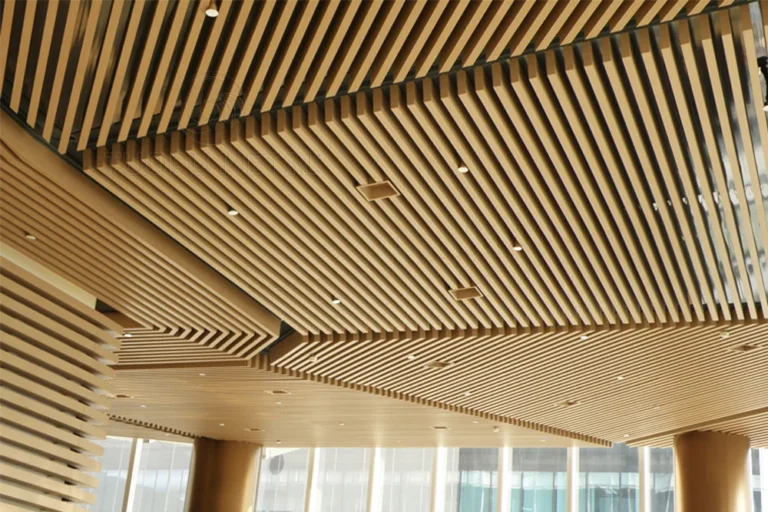
Export Packing, Container Loading, and After-Sales Documentation
Hospital projects in North America and Europe often receive panels by container. Confirm packing and loading procedures with the supplier to avoid transit damage and customs delays:
| Item to Confirm | Why It Matters |
|---|---|
| Panel orientation and bracing inside the container | Prevents scratching of finished faces and distortion of large-format sheets |
| Moisture-barrier wrapping for each layer | Critical for PVDF and anodized finishes exposed to sea humidity |
| Loading sequence and weight distribution on the container floor | Avoids crushing of lower layers; heavier panels on the bottom |
| Export documentation: packing list, certificate of origin, material test reports | Required by customs and by the installing contractor’s QA file |
| On-site installation support scope | FstopMetal provides technical support and installation guidance for international projects; confirm what is included (video walk-through, on-site supervision, fastener schedule) |
After delivery, the supplier should furnish a final documentation package: as-built shop drawings, finish-batch colour reference cards, acoustic test results tied to the installed configuration, and any EPD or sustainability documentation the project architect needs for the building’s environmental report. Retain all of this for the facility-management file, as future corridor renovations will reference the original panel specification.
Frequently Asked Questions
What perforation rate should I specify for a hospital corridor ceiling or wall?
The perforation rate is adjustable across the AP300 series and should be driven by the acoustic target (NRC) and visual intent. Run the target NRC through the supplier’s acoustic calculation, specify the hole diameter, pitch, and pattern, and confirm the result in a sample panel before production. The exact rate depends on panel thickness, backing material, and cavity depth, so a single number cannot be quoted without the full design package.
Which surface finish is most suitable for a high-traffic hospital corridor?
Powder coating (60–80 µm) and PVDF (25–30 µm) are the two most common choices for institutional interiors because of their colour range and resistance to cleaning chemicals. Anodizing (15–25 µm) offers a metallic look but a narrower palette. Wood-grain transfer is available for patient-facing areas where a softer visual is preferred. Confirm the finish’s chemical-resistance test report for the specific disinfectants the hospital plans to use, and agree the warranty scope in the contract.
Can the supplier provide a fire-performance report for the exact panel I am specifying?
Fire-rating requirements vary by jurisdiction and building type. The supplier must produce a third-party test report covering the specific panel thickness, alloy temper, finish, and backing configuration in your design. If no report exists for that combination, the panel cannot be specified in a jurisdiction that mandates fire classification. Ask the supplier which test standard was applied and whether the report can be shared under NDA before contract signature.
What does the export packing include for a container of perforated panels?
Each panel is typically wrapped in a moisture barrier, bunched in sets, and braced to prevent shifting. Heavier or larger panels are loaded at the container floor. The shipping documentation should include a detailed packing list, certificate of origin, material mill certificates, and finish-batch references. Confirm the packing method and document the loading photos with the supplier so that any transit claim is traceable to a specific container and position.
What after-sales documentation should I receive with the delivery?
Request as-built shop drawings, finish colour reference cards (tied to batch numbers), acoustic test results for the installed configuration, the fire-performance report, and any EPD or sustainability statement. FstopMetal provides technical support and installation guidance for international projects; clarify in the contract whether that includes on-site supervision, a fastener and fixings schedule, and a panel-replacement protocol. All of these documents feed the facility’s long-term maintenance and renovation file, so retain digital copies in your project management system.
To run this checklist against a live project, contact TOP METAL & TUORUNDA — Jimmy, WhatsApp: +86-139-2919-8578, email: sales2@trdoutdoor.com. Provide your panel dimensions, perforation pattern, finish, backing material, and target NRC; the team will confirm which test reports and certifications are available for your specific configuration and arrange a sample for review.
Talk to Our Team
Planning a project or comparing suppliers? Send us your drawings, panel schedule or quantity list and we will come back with a specification proposal and a budget range for your review.
- Company: TOP METAL & TUORUNDA
- Contact: Jimmy
- WhatsApp: +86-139-2919-8578
- Email: sales2@trdoutdoor.com