
What Buyers Must Confirm About Aluminum Pergola Manufacturing Tolerances for Data Center Installations
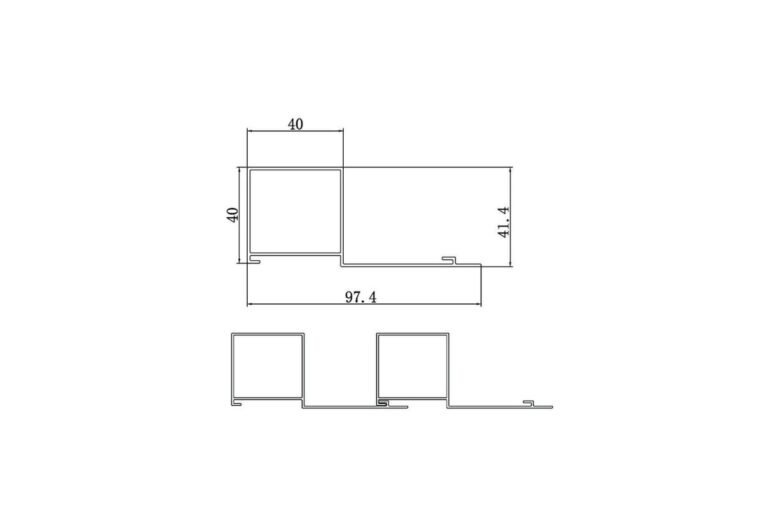
Manufacturing tolerance for aluminum pergolas refers to the allowable deviation from nominal dimensions across all structural members, connection interfaces, and surface finishes. Data center deployments demand tighter geometric control because pergola structures often carry auxiliary equipment such as solar panels, LED lighting arrays, and rain-sensing actuation hardware—all of which require precise mounting interfaces. Buyers should treat tolerance verification as a standalone quality gate before placing a purchase order.
Why Dimensional Control Matters Specifically for Data Center Pergola Systems
Data center environments introduce constraints that most standard architectural pergolas do not encounter. The following factors make tolerance specification critical:
- Integral mounting rails for BIPV or photovoltaic panel trays must align within millimeter-level variation, otherwise panel clamping hardware cannot be seated correctly during field assembly.
- Thermal expansion differentials between the pergola framework and adjacent building envelope materials can compound misalignment if initial fabrication tolerances are already loose.
- IPTV-integrated smart pergola variants such as the G300 series include rain sensors, auto-louver actuators, and embedded LED circuits; misaligned mounting holes force rework on site and risk damaging waterproof cable glands.
- Service and maintenance access routes installed beneath pergola canopies require consistent clearances so mobile equipment platforms fit through predefined pathways.
The Gap Between Nominal Drawing and As-Built Dimension
A common source of procurement friction is the assumption that a shop drawing dimension equals the fabricated part dimension. In practice, extrusion draw length, machining cut tolerance, and powder-coating thickness all add up. Buyers should ask the supplier for a documented tolerance band expressed per parameter—length, width, flatness, hole position, and surface coat build—not a single vague statement.
| Tolerance Parameter | Why It Matters for Data Centers | What the Buyer Should Request from Supplier |
|---|---|---|
| Extrusion length | Beam span accuracy determines load distribution across support columns | Mechanical cut tolerance range documented in third-party test report |
| Hole position / pattern | Mounting brackets for solar, louver, and sensor assemblies depend on repeatability | CNC drill pattern verification report or first-article inspection record |
| Surface coating thickness | Affects fastener engagement depth and torque specification on exterior connections | Coating thickness measurement method and acceptable range per IACS or equivalent standard |
| Flatness / twist of panel surfaces | Impacts aesthetic continuity of canopy planes visible above rooftop equipment areas | Flatness check procedure with measurable limit values |
| Material grade certification | Ensures specified alloy properties meet structural design assumptions | Mill test certificate for 6063-T5/T6 aluminum with composition and mechanical property results |
Certifications and Third-Party Verification to Confirm Before Ordering
Purchasing managers working on data center projects should not accept a supplier’s written guarantee as sufficient evidence of manufacturing discipline. Instead, request the following documents and verify their origin against independent bodies:
- ISO 9001 — confirms that a documented quality-management system exists for production control, but the scope of that system should be checked against the specific product lines supplied.
- CE marking documentation — demonstrates conformity assessment steps taken for products intended for certain markets, including declared performance parameters.
- SGS reports — independent verification records for material composition, coating adhesion, salt-spray resistance, or other test protocols the buyer specifies.
- First-article inspection report — a measured comparison between the approved sample and the production run, showing that tolerances are being held consistently.
For data center contracts, the audit trail matters more than the certificate itself. Ask the supplier to share redacted inspection reports so the procurement team can confirm the testing methodology matches project specifications.
Sample Policy and Pre-Production Validation Checklist
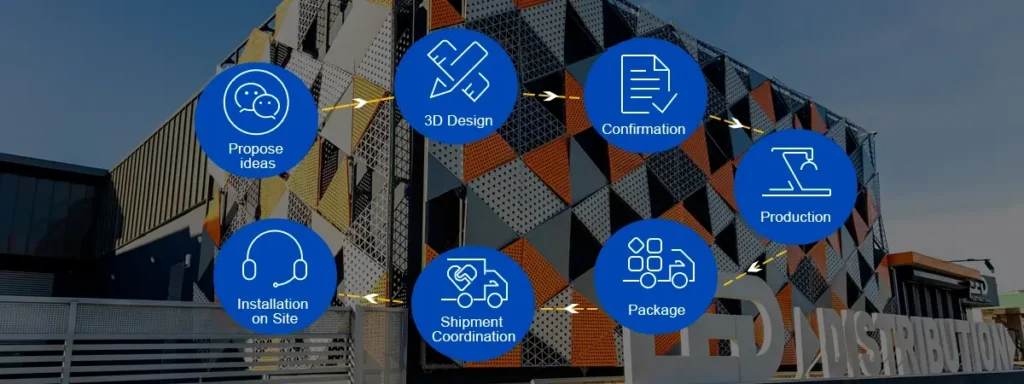
A practical way to validate a manufacturer’s tolerance capability is to run a controlled sample evaluation before committing to volume orders. Use the following checklist:
- Request physical samples from the exact product series intended for the project, such as G100 modern cantilever variants or G300 motorized louvred units.
- Measure all critical dimensions on-site using calibrated calipers, tape, and straight-edge tools; compare results against the approved shop drawing.
- Verify hole positions by attempting to pass the corresponding fixture hardware through every fastener point without modification.
- Check finish uniformity across multiple pieces from the same batch to confirm coating consistency.
- Confirm that samples match the material grade listed in the commercial specification, not a generic fallback.
- Document discrepancies immediately and require a corrective-action response that shows whether the issue is isolated or systemic.
If the supplier’s sample kit includes only unperforated showcase pieces and refuses to submit representative production-quality units for measurement, this is a signal that tolerance confidence may not be demonstrated empirically.
Shop Drawing Review, CNC Capability, and Export Packing Standards
Shop Drawing and CNC Cross-Check
Data center pergola assemblies frequently involve parametric layouts, custom radii, and coordinated penetrations for utilities. Before approval, verify the following shop drawing items:
- All member sizes are derived from CNC-cut programs, not manual cutting allowances.
- Connection details specify accepted fastener grades and torque limits suitable for outdoor equipment-mounting applications.
- Drawing revisions carry version stamps so the factory produces the latest confirmed geometry.
- BOM references correspond one-to-one with extrusion profiles, fabrications, and coating requirements.
Container Loading and Protection During Export
Dimensional accuracy claimed on paper can degrade during sea freight if packing is inadequate. The buyer should confirm:
- Individual extrusions are wrapped or bundled to prevent surface contact damage that could affect fit-up.
- Boxes and crates are loaded to maximize container utilization while maintaining stack-stability ratings provided by the supplier.
- Packing lists reflect net package counts, gross weights, and dimensions per master carton so receiving teams can plan crane or fork-lift staging at the destination port.
- Hazardous-content declarations, if applicable, comply with international shipping regulations.
After-Sales Technical Documentation and Ongoing Quality Surveillance
Tolerance assurance does not end at delivery. For long-duration data center projects spanning multiple phased installations, the buyer should establish a documentation handover protocol that includes:
- As-built measurement records for each delivered batch compared against the original tolerance spec.
- Retained samples stored under agreed conditions to allow retrospective comparison if field disputes arise.
- Clear escalation paths for non-conforming parts, specifying replacement turnaround based on verified inventory policy.
- Post-installation photo and measurement logs shared back to the manufacturer to close the quality loop.
Contact Jimmy at TOP METAL & TUORUNDA via WhatsApp at +86-139-2919-8578 or email sales2@trdoutdoor.com to request the current tolerance verification checklist and sample submission policy for your project scope.
Frequently Asked Questions
What tolerance documents should a data center buyer request before awarding an aluminum pergola order?
Request ISO 9001 registration scope, CE conformity evidence, SGS test reports relevant to your project parameters, a first-article inspection report, and mill test certificates for the specified aluminum alloy grade.
Can a supplier rely solely on their own measurement tools instead of third-party lab reports?
No. Internal measurements document process capability but do not provide independent verification. Require third-party test reports and sampled inspection records that can be audited against agreed project standards.
How should sample acceptance be handled for CNC-fabricated pergola components?
Evaluate representative production samples against the approved shop drawing, measure every critical interface, verify hole patterns with actual hardware, and retain marked samples for future batch comparison.
What packing and loading checks protect dimensional accuracy during overseas shipment?
Confirm individual wrapping for extrusions, verify crate stacking stability, ensure packing lists match shipment contents precisely, and require suppliers to declare container utilization plans before booking space.
Which documentation should be retained after installation to support warranty and compliance audits?
Keep as-built measurement records, retained batch samples, revision-controlled shop drawings, third-party test reports, and post-installation photos. These documents collectively demonstrate that tolerances were met throughout manufacture, transport, and erection.
Talk to Our Team
Planning a project or comparing suppliers? Send us your drawings, panel schedule or quantity list and we will come back with a specification proposal and a budget range for your review.
- Company: TOP METAL & TUORUNDA
- Contact: Jimmy
- WhatsApp: +86-139-2919-8578
- Email: sales2@trdoutdoor.com