
The short answer
Sourcing aluminum curtain wall panels for school buildings requires a structured handover process that covers certified material specs, pre-production samples, approved shop drawings, documented dimensional tolerances, compliant export packaging, and complete after-sales technical files. Buyers should request evidence — not claims — at every step so the installed facade meets local building codes, durability expectations, and maintenance budgets over the full project lifecycle.

What to verify before ordering: certification and third-party test reports
School projects carry higher scrutiny than many commercial applications because they serve vulnerable occupants and often fall under stricter public-building procurement rules. The first step in any sourcing workflow is confirming that the supplier can provide verifiable documentation, not just marketing statements.
- CE marking: Required for European-market projects. Confirm the declaration of performance (DoP) is available for the specific panel system and finish you are specifying.
- ISO 9001: Indicates a documented quality management system. Request the certificate number and confirm it covers the product line you are purchasing.
- SGS certification: Third-party validation of material composition, coating thickness, and performance tests. Ask whether the report is issue-specific or generic.
- EPD (Environmental Product Declaration): Increasingly required for green-building compliance. FstopMetal offers EPD-compliant aluminum curtain wall panel systems.
Test reports you should explicitly ask for
| Test Area | Why It Matters for Schools | Document to Request |
|---|---|---|
| Wind load / structural performance | Facade safety under extreme weather | Third-party test report per EN 12127 or ASTM E330 |
| Water penetration | Prevent interior moisture damage | Test certificate with rated pressure value |
| Air infiltration | Building energy efficiency | Test result in m³/(m²·h) |
| Fire performance | Life-safety compliance | Report must reference the applicable standard; rating varies by jurisdiction and must be verified by a third-party report |
| Coating adhesion & salt spray | Long-term finish durability | ASTM D1654 / ISO 9227 results |
| Thermal transmittance (U-value) | Energy code compliance | Calculated or tested U-value data |
Sample policy and shop-drawing approval workflow
Before mass production begins, a reliable supplier will move through a sample-and-approval stage that protects both the architect and the contractor. This stage is where most specification misunderstandings are resolved — and skipping it is a common sourcing mistake.
Physical sample review
- Request an actual-size sample panel representing the chosen series (AP Series solid panel, AP300 perforated, or AP200 curved).
- Verify surface finish color against the agreed RAL or custom label under consistent lighting conditions.
- Check coating thickness with a magnetic induction gauge; typical powder-coat range is 60–80 microns, PVDF range is 25–30 microns, and anodizing range is 15–25 microns.
- Inspect edge treatment, corner construction, and any integral framing or reinforcement.
Shop-drawing submission and approval
Shop drawings translate architectural intent into fabrication-ready detail. For a school curtain wall project, the package should include:
- Elevations showing panel layout, joint widths, and expansion joints
- Section details at slab edges, window openings, and roof termination
- Mullion and transom profiles with connection points to the building structure
- Perforation patterns and open-area percentages for acoustic or ventilated facades
- Loading calculations and fixings schedule
The buyer should require that all shop drawings carry the supplier’s engineering stamp and a clear revision log. CNC-based fabrication ensures each panel matches the approved geometry within stated tolerances.
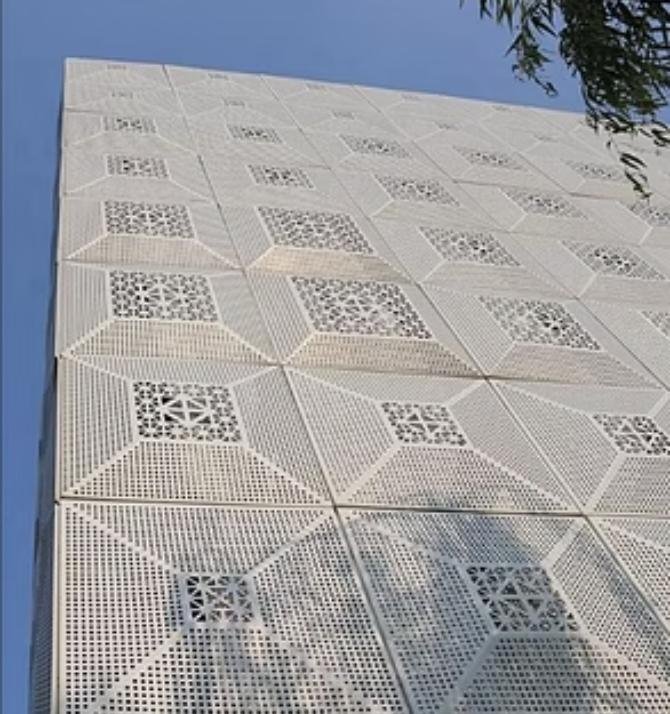
Tolerance handover: what acceptable dimensional variation looks like
Dimensional tolerance is the silent determinant of field installation speed and final façade appearance. Panels that exceed tolerance bands create gaps, misaligned joints, and costly on-site modifications. When evaluating a supplier, ask for their published tolerance table and confirm it references the relevant standard.
| Panel Dimension | Typical Tolerance Band | Impact of Non-Conformance |
|---|---|---|
| Overall length / width | ±1.0 mm (up to 2 m); ±1.5 mm (above 2 m) | Gap inconsistency; difficulty aligning adjacent panels |
| Diagonal difference | ≤2.0 mm for rectangular panels | Panel appears skewed when installed |
| Surface flatness | ≤1.5 mm per 1 m span | Visible waviness under oblique light |
| Hole / slot position | ±0.5 mm | Mismatch with fasteners or accessories |
| Thickness | ±0.1 mm from nominal | Structural capacity deviation |
FstopMetal fabricates AP Series panels using CNC equipment and maintains tolerance control throughout the forming, cutting, and finishing stages. The铝合金 substrate options include 6063 standard-grade alloy, with heat-treated 6063-T5/T6 variants available where higher strength is specified. Always confirm the tolerance class for your specific order during the technical clarification stage.
Export packaging, container loading, and on-site handover documentation
Curtain wall panels are large, flat, and finish-sensitive. Packaging failures are among the leading causes of field claims, so the shipping phase deserves the same rigor as the design phase.
Packaging standards to specify
- Each panel wrapped in protective film or foam interleaving to prevent coating scratches
- Corner guards on every bundle to protect edges during handling
- Palletized or crated with steel strapping and weather-resistant outer wrapping
- Carton or label identifying panel ID, elevation reference, and orientation mark
Container loading planning
Because panel dimensions and quantities vary per project, container loading should be planned jointly between the buyer and supplier. Considerations include:
- Maximizing board-feet per container to reduce unit freight cost
- Securing bundles to prevent shifting during ocean transit
- Providing a loading plan diagram so site teams know which bundle corresponds to which elevation
After-sales and handover documents
A professional supplier delivers a documentation package alongside the shipment:
- Mill certificates for the aluminum alloy used
- Coating test reports for the applied finish
- As-built shop drawings reflecting any field-approved modifications
- Installation guide tailored to the panel system
- Maintenance recommendations for the selected surface treatment
- Contact record for technical support during erection
FstopMetal provides technical support and installation guidance for international projects, including those serving educational facilities.
Key sourcing questions to send suppliers upfront
To streamline the evaluation process, architects and procurement managers can circulate this question set before requesting quotes:
- Can you provide CE DoP and SGS test reports for the exact panel system and finish we are specifying?
- What is your sample policy — lead time, cost, and modification process?
- Can you produce shop drawings from our architectural CAD files and submit them for approval?
- What dimensional tolerance class do you commit to, and can you provide it in writing?
- How do you pack curtain wall panels for ocean export, and can you provide a loading plan?
- What after-sales documentation and technical support do you provide post-shipment?
- Which alloy tempers (6063-T5 / 6063-T6) are available, and what surface finishes can you apply?
For project confirmation and to discuss your specific curtain wall requirements, contact TOP METAL & TUORUNDA. Reach Jimmy via WhatsApp at +86-139-2919-8578 or email sales2@trdoutdoor.com.
Frequently Asked Questions
What certifications should an aluminum curtain wall supplier for schools have?
Look for CE marking with a valid declaration of performance, ISO 9001 for quality management, and SGS third-party test validation. For projects requiring sustainability credentials, confirm whether EPD certification is available for the panel system.
How does the sample approval process work before mass production?
The supplier produces an actual-size sample panel with the specified alloy, finish, and dimension. The buyer inspects color, coating thickness, edge treatment, and flatness. Once the sample is approved in writing, it becomes the quality baseline for the full production run.
What tolerances should I expect on fabricated aluminum curtain wall panels?
Typical tolerance bands are ±1.0 mm for dimensions up to 2 meters, ≤2.0 mm diagonal difference for rectangular panels, and ≤1.5 mm per meter for surface flatness. These values should be stated in the supplier’s technical datasheet and confirmed before ordering.
How should curtain wall panels be packed for international container shipment?
Each panel should be individually protected with film or foam, bundled on pallets with corner guards, strapped with steel banding, and wrapped in weather-resistant material. A labeled loading plan should identify each bundle’s corresponding elevation and panel ID.
What documentation should arrive with a school curtain wall order?
The delivery package should include mill certificates, coating and performance test reports, as-built shop drawings, an installation guide, maintenance instructions for the selected finish, and a technical support contact record for the erection phase.
Talk to Our Team
Planning a project or comparing suppliers? Send us your drawings, panel schedule or quantity list and we will come back with a specification proposal and a budget range for your review.
- Company: TOP METAL & TUORUNDA
- Contact: Jimmy
- WhatsApp: +86-139-2919-8578
- Email: sales2@trdoutdoor.com