


Aluminum Curtain Wall Panels Outperform Gypsum Board in Hospital Corridor Applications
For hospital corridors, aluminum curtain wall panels are the stronger choice over gypsum board. They deliver superior moisture resistance, impact durability, design flexibility, and lower lifecycle maintenance. Gypsum board remains a budget option for low-traffic interior partitions but falls short where hygiene, acoustics, and long-term resilience are non-negotiable. FstopMetal, operating since 2003, manufactures AP Series aluminum panels in Foshan, China, for projects across 36+ countries.
Why Hospital Corridors Demand High-Performance Cladding
Hospital corridors are among the most demanding interior environments in any healthcare facility. They experience constant foot traffic, frequent equipment movement, exposure to cleaning chemicals, and strict infection-control requirements. Wall and ceiling surfaces in these spaces must withstand aggressive disinfection routines while maintaining a clean, professional appearance over decades of use.
Key performance criteria for hospital corridor cladding include:
- Moisture and mold resistance — corridors in clinical zones often have elevated humidity
- Impact and abrasion resistance — gurneys, IV poles, and carts create repeated contact
- Hygienic, cleanable surfaces — smooth, non-porous finishes resist microbial buildup
- Fire compliance — fire rating requirements vary by jurisdiction and must be verified by a third-party report
- Acoustic control — NRC performance reduces noise transmission between wards
- Aesthetic consistency — uniform appearance supports wayfinding and patient comfort
Aluminum curtain wall panels meet these criteria more comprehensively than traditional gypsum board, which is porous, susceptible to water damage, and requires repainting to maintain appearance.
Aluminum Curtain Wall Panels: Technical Advantages for Healthcare
Aluminum curtain wall panels, such as the AP Series from FstopMetal, offer a range of engineered benefits specifically relevant to hospital corridor applications.
Material and Structural Performance
Aluminum alloy 6063-T5/T6 provides high strength-to-weight ratio, meaning panels can span larger distances with fewer supports. This is particularly valuable in corridor ceiling applications where long, uninterrupted runs are common. The material is inherently non-corrosive and does not rust, warp, or degrade when exposed to moisture or cleaning agents.
Surface Finish Options
Multiple surface treatments are available to meet different clinical and aesthetic requirements:
- Powder coating at 60–80 microns for durable, color-consistent finishes
- Anodizing at 15–25 microns for a hard, wear-resistant metallic surface
- PVDF (Kynar 500) coating at 25–30 microns for superior UV and chemical resistance
- Wood grain transfer for warmer aesthetic environments
Warranty coverage for finishes varies by product series and coating type, and is specified in the project contract.
Acoustic and Thermal Performance
Perforated aluminum panels, such as the AP300 series, can be combined with acoustic backing materials including foam or mineral wool to achieve NRC ratings up to 0.85+. This makes them suitable for corridor ceilings where noise reduction between patient rooms and waiting areas is critical. Thermal performance is also strong, with U-values as low as 0.8 W/m²K for ventilated curtain wall systems.
Sustainability Credentials
Aluminum curtain wall panels contain up to 75% recycled aluminum content and are 100% recyclable at end of life. EPD (Environmental Product Declaration) certification is available for projects requiring sustainable building documentation. These credentials support LEED and BREEAM compliance for healthcare facilities pursuing green building certification.
Design Flexibility
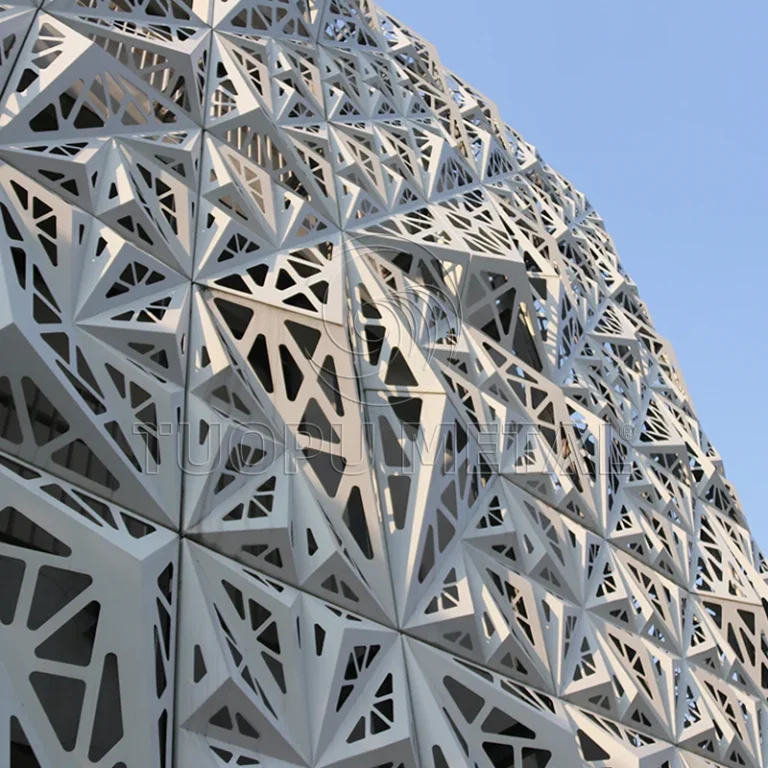
The AP Series offers multiple configurations including solid panels (AP Series), perforated decorative panels (AP300), curved panels (AP200), and unitized curtain wall systems. Corridor designs can incorporate custom geometries, parametric patterns, and integrated lighting channels without compromising structural integrity.
Gypsum Board: Limitations in Hospital Corridor Environments
Gypsum board remains widely specified for interior partitions and ceilings due to its low upfront cost and ease of installation. However, its limitations in healthcare settings are significant.
| Performance Factor | Aluminum Curtain Wall Panel | Gypsum Board |
|---|---|---|
| Moisture resistance | Inherent — does not absorb water | Porous — swells and degrades when wet |
| Impact resistance | High — 6063-T5/T6 alloy withstands repeated contact | Low — dents and cracks easily |
| Surface cleanability | Smooth, non-porous, chemical-resistant | Painted surface requires recoating after heavy cleaning |
| Mold and microbial resistance | Inherent — no organic material to support growth | Organic paper facing can support mold in humid conditions |
| Acoustic performance (ceiling) | NRC up to 0.85+ with perforated panels and backing | Basic sound absorption; limited NRC without added treatment |
| Fire compliance | Fire rating requirements vary by jurisdiction; must be verified by a third-party report | Gypsum is inherently fire-resistant but joint treatment is the weak point |
| Lifespan and maintenance | Decades with minimal maintenance; finish warranty per contract | Requires periodic repainting; prone to damage and replacement |
| Design versatility | Perforated, curved, parametric, integrated lighting | Flat planes only; limited aesthetic options |
| Sustainability | Up to 75% recycled content; 100% recyclable; EPD available | Recyclable but energy-intensive to manufacture; no recycled content advantage |
| Installation complexity | Factory预制, system-based installation | On-site cutting and finishing required |
Cost Considerations: Lifecycle vs. Upfront Investment
When comparing aluminum curtain wall panels and gypsum board, the relevant metric is total lifecycle cost, not initial material price. Gypsum board has a lower upfront cost, but hospital corridors require frequent repair and replacement due to impact damage, moisture exposure, and surface degradation. Each replacement cycle involves downtime, labor, and material costs that accumulate significantly over a 15- to 20-year facility lifespan.
Aluminum curtain wall panels carry a higher initial investment but eliminate the recurring costs associated with gypsum board maintenance. Key cost drivers for aluminum panels include alloy grade, coating system, panel thickness, perforation complexity, and finish customization. Projects with unitized curtain wall systems benefit from faster on-site installation, which reduces labor costs and minimizes disruption to hospital operations.
Specification trade-offs typically involve selecting the appropriate coating system for the corridor’s exposure level. High-traffic clinical corridors benefit from PVDF coatings for maximum chemical and abrasion resistance, while administrative corridors may specify powder coating at a lower cost point. Perforated acoustic panels carry a premium over solid panels but deliver measurable noise reduction benefits in patient-facing environments.
Specification and Compliance Workflow
Specifying aluminum curtain wall panels for hospital corridors requires attention to local building codes and healthcare facility standards. Fire rating requirements vary by jurisdiction, and compliance must be verified through third-party testing reports specific to the project location. CE certification supports European market compliance, while SGS certification and ISO 9001 quality management systems provide assurance of manufacturing consistency.
Architects and contractors should request project-specific technical data sheets, including acoustic ratings, coating specifications, and fire performance documentation, before finalizing specifications. FstopMetal offers EPD-certified options for projects requiring environmental product declarations, and custom panel configurations are available for complex corridor geometries.
When Gypsum Board May Still Be Appropriate
Gypsum board remains a viable option for low-traffic interior partitions in administrative or non-clinical areas of a hospital. Where moisture exposure is minimal, impact risk is low, and budget constraints are primary, gypsum board can meet code requirements at a lower initial cost. However, for any corridor serving clinical functions, patient transport routes, or high-traffic circulation spaces, aluminum curtain wall panels provide materially better long-term value.
Conclusion
For hospital corridors, aluminum curtain wall panels are the technically superior specification. They address the core demands of healthcare environments — hygiene, durability, acoustics, and compliance — while offering design flexibility that gypsum board cannot match. The lifecycle cost advantage becomes increasingly clear as maintenance cycles accumulate. Projects should engage with manufacturers early in the specification phase to ensure panel configurations align with acoustic, thermal, and aesthetic requirements.
For technical specifications, project consultation, or custom panel design support, contact TOP METAL & TUORUNDA. Reach Jimmy via WhatsApp at +86-139-2919-8578 or email sales2@trdoutdoor.com.
Frequently Asked Questions
Are aluminum curtain wall panels suitable for high-humidity hospital environments?
Yes. Aluminum is inherently moisture-resistant and does not absorb water, warp, or support mold growth. This makes it suitable for hospital corridors, patient rooms, and clinical support areas where humidity levels may be elevated or cleaning chemicals are frequently applied.
What acoustic performance can aluminum ceiling panels achieve in hospital corridors?
Perforated aluminum panels, when combined with acoustic backing materials such as foam or mineral wool, can achieve NRC ratings up to 0.85+. This provides significant noise reduction between corridor spaces and adjacent clinical or patient areas.
Do aluminum curtain wall panels meet hospital fire code requirements?
Fire rating requirements vary by jurisdiction. Compliance must be verified by a third-party test report for the specific product and project location. Architects should request fire performance documentation from the manufacturer before finalizing specifications.
How does the lifecycle cost of aluminum panels compare to gypsum board in hospital corridors?
While aluminum panels have a higher upfront cost, they eliminate the recurring expenses of gypsum board repair, replacement, and repainting. Over a 15- to 20-year period, the total lifecycle cost of aluminum panels is typically lower, particularly in high-traffic clinical corridors where damage frequency is high.
Can aluminum curtain wall panels be customized for complex hospital corridor designs?
Yes. FstopMetal offers custom panel configurations including curved panels (AP200 series), perforated decorative patterns (AP300 series), and unitized curtain wall systems. Parametric designs, integrated lighting channels, and custom finishes are available to meet specific architectural requirements.
Talk to Our Team
Planning a project or comparing suppliers? Send us your drawings, panel schedule or quantity list and we will come back with a specification proposal and a budget range for your review.
- Company: TOP METAL & TUORUNDA
- Contact: Jimmy
- WhatsApp: +86-139-2919-8578
- Email: sales2@trdoutdoor.com