


Direct Answer
For parking structures, perforated metal panels are generally the better choice due to their lower cost, excellent ventilation, acoustic absorption, and straightforward installation. Aluminum honeycomb panels offer superior rigidity and thermal performance but at a higher price point, making them suitable for premium or architecturally driven projects where structural spans and energy efficiency are priorities.
Understanding the Two Materials
Aluminum honeycomb panels and perforated metal panels serve different performance niches in parking structure applications. Both are aluminum-based solutions, but their construction and behavior under real-world conditions diverge significantly.
Aluminum Honeycomb Panels
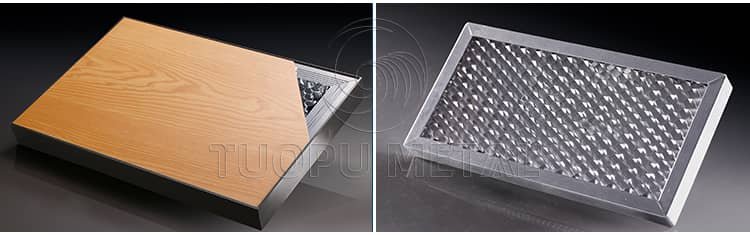
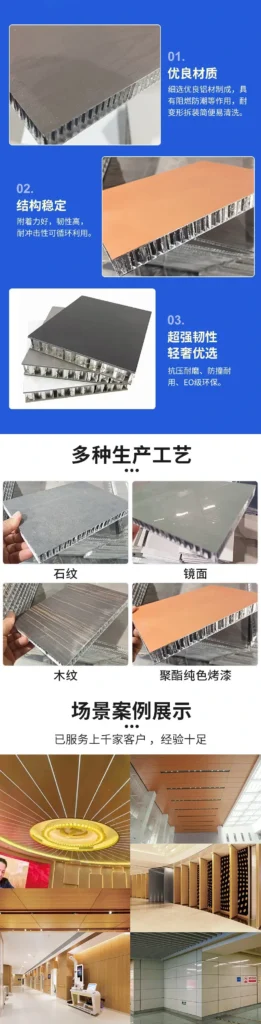
An aluminum honeycomb panel consists of two thin aluminum face sheets bonded to a hexagonal honeycomb core made from aluminum foil. This sandwich structure delivers exceptional stiffness-to-weight ratio, meaning a relatively thin panel can span larger distances without deflection. The closed-cell core also provides thermal insulation and sound damping properties that solid perforated panels cannot match.
Perforated Metal Panels
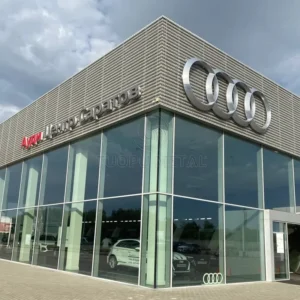
Perforated metal panels are solid aluminum sheets (typically 6063-T5 or 6063-T6 alloy) with a pattern of precision-cut holes. The perforation rate — the percentage of open area — determines how much light, air, and sound pass through. These panels are lighter than solid sheet but heavier per unit area than honeycomb constructions at equivalent thickness. They are widely used for facade cladding, sunshades, and interior ceiling applications in parking facilities.
Performance Comparison for Parking Structures
Parking structures present a unique set of demands: vehicle exhaust dispersion, acoustic control, structural span requirements, fire compliance, and long-term durability in an exposed environment. The table below summarizes how each material type performs across these criteria.
| Performance Factor | Aluminum Honeycomb Panel | Perforated Metal Panel |
|---|---|---|
| Structural Rigidity | Very high — honeycomb core resists bending and deflection over long spans | Moderate — relies on panel thickness and support framing |
| Weight | Lightweight for given stiffness | Heavier per square meter at equivalent rigidity |
| Ventilation | Poor — solid face sheets block airflow unless specifically vented | Excellent — open perforation area allows natural air exchange |
| Acoustic Performance | Good sound damping from core mass | Good when paired with acoustic backing; NRC up to 0.85+ with perforated ceiling configurations |
| Thermal Insulation | High — honeycomb core acts as insulating layer | Low — solid metal conducts heat |
| Fire Compliance | Fire rating requirements vary by jurisdiction and must be verified by a third-party report | Fire rating requirements vary by jurisdiction and must be verified by a third-party report |
| Corrosion Resistance | High — powder-coated or PVDF-finished aluminum resists road salts and exhaust | High — same surface treatment options available |
| Design Flexibility | Limited to flat or gently curved geometries | High — can be formed, curved, and perforated in custom patterns |
| Recyclability | 100% recyclable aluminum | 100% recyclable aluminum |
Cost Drivers and Specification Trade-offs
When evaluating aluminum honeycomb panels against perforated metal for a parking structure, the cost conversation centers on several interrelated factors rather than a simple per-square-meter comparison.
- Material construction: Honeycomb panels require a multi-layer manufacturing process — face sheet preparation, adhesive bonding, core expansion, and lamination. Perforated panels involve sheet forming and CNC punching, which is a simpler and faster production sequence.
- Span and support requirements: Honeycomb panels can span greater distances between support members, potentially reducing the amount of underlying framework. Perforated panels may require closer stud or mullion spacing, which adds to structural material and labor costs.
- Surface finish: Both panel types accept powder coating, anodizing, and PVDF finishes. Thicker film builds (such as PVDF at 25–30 microns) add cost but are often specified for parking structures exposed to de-icing salts and vehicle emissions.
- Acoustic treatment: Perforated panels used as interior ceiling or wall cladding in parking structures often require acoustic backing material (foam or mineral wool) to achieve target NRC values. Honeycomb panels provide inherent damping but may still need supplementary absorption in high-noise zones.
- Installation speed: Larger honeycomb panels cover more area per piece, which can reduce on-site labor. Perforated panels are lighter to handle but may require more individual pieces to cover the same area.
The total installed cost for a parking structure project depends on the interplay of these variables. A specification that calls for honeycomb panels on the exterior facade and perforated panels on the interior ceiling is common — each material performs where its strengths matter most.
Ventilation and Air Quality in Parking Structures
Ventilation is one of the most critical performance requirements for enclosed and semi-enclosed parking structures. Vehicle exhaust contains carbon monoxide, nitrogen oxides, and particulate matter that must be dispersed to meet indoor air quality standards.
Perforated metal panels excel in this application because the open area allows natural airflow through the facade or ceiling assembly. The perforation pattern can be engineered to direct airflow while maintaining aesthetic intent. FstopMetal offers AP300 perforated panels with adjustable perforation rates, allowing designers to balance ventilation needs against privacy and solar shading requirements.
Honeycomb panels, by contrast, present solid aluminum faces that block airflow. They can be used in parking structures where ventilation is handled by a dedicated mechanical system, but they cannot contribute to natural air exchange. For structures relying on passive ventilation strategies, perforated panels are the more functional choice.
Acoustic Considerations
Parking structures generate significant noise from engines, tires, and reverberation off hard surfaces. Acoustic management is important for both worker comfort and compliance with noise ordinances at adjacent properties.
Perforated metal ceiling and wall panels, when combined with an acoustic backing layer, can achieve NRC ratings of 0.85 or higher. This makes them effective at absorbing engine noise and reducing reverberation time. The AP series perforated panels from FstopMetal are designed for this application, with hole patterns optimized for broadband sound absorption.
Honeycomb panels provide mass-based sound damping but do not absorb sound in the same way. They are more effective at blocking sound transmission between zones than at reducing noise within a zone. For interior parking structure applications where noise reduction is the goal, perforated panels with acoustic backing are typically the preferred solution.
Maintenance and Longevity
Parking structures are harsh environments. De-icing salts, UV exposure, temperature cycling, and chemical emissions from vehicles all challenge facade and ceiling materials. Both honeycomb and perforated aluminum panels perform well when specified with appropriate surface treatments.
- Powder coating at 60–80 microns provides a durable, color-stable finish suitable for most parking structure environments.
- PVDF (Kynar 500) at 25–30 microns offers superior UV resistance and chemical resistance, recommended for structures in coastal or high-pollution areas.
- Anodizing at 15–25 microns provides a hard, wear-resistant surface with a metallic appearance, though color options are more limited.
Regular maintenance for both panel types is minimal. Occasional washing with mild detergent removes salt deposits and road grime. The warranty scope for each product series and surface treatment is defined in the project contract.
Sustainability and Environmental Profile
Sustainability is increasingly a specification requirement for parking structures, particularly for public and institutional projects. Both aluminum honeycomb and perforated panels share a strong environmental profile:
- Aluminum is 100% recyclable without degradation of properties.
- Recycled aluminum content can reach up to 75%, reducing the embodied carbon of the material.
- EPD (Environmental Product Declaration) certification is available for select product lines, supporting green building credit applications.
- Honeycomb panels contribute to energy efficiency through thermal insulation, reducing HVAC loads in climate-controlled parking facilities.
When to Specify Each Panel Type
The decision between aluminum honeycomb and perforated metal panels in a parking structure comes down to project priorities. The following guidelines can help architects and specifiers make the right call.
Choose Perforated Metal Panels When
- Natural ventilation is a design requirement or cost constraint
- Acoustic absorption is needed for interior noise control
- Budget is a primary driver and cost efficiency is important
- Custom perforation patterns are desired for architectural expression
- The application is interior ceiling or wall cladding in the parking structure
Choose Aluminum Honeycomb Panels When
- Long spans between structural supports are required on the exterior facade
- Thermal insulation is a priority for energy code compliance
- A flat, seamless aesthetic is desired with minimal joint visibility
- The project targets premium certification or sustainability credits
- Mechanical ventilation handles air quality, freeing the facade from that requirement
Frequently Asked Questions
Can aluminum honeycomb panels be used for parking structure ventilation?
Aluminum honeycomb panels have solid face sheets that do not permit airflow. They cannot contribute to natural ventilation. If ventilation is required, perforated metal panels or a combination strategy using perforated panels in ventilated zones and honeycomb panels elsewhere is the appropriate approach.
Do perforated metal panels meet fire code requirements for parking structures?
Fire rating requirements vary by jurisdiction. The fire performance of any panel system must be verified by a third-party report specific to the product configuration and installation method. Specifiers should request the relevant test documentation from the manufacturer before finalizing the specification.
What surface finish is recommended for parking structure exterior panels?
PVDF (Kynar 500) finish is recommended for exterior parking structure applications exposed to road salts and vehicle emissions, as it provides the highest resistance to UV degradation and chemical attack. Powder coating at 60–80 microns is a cost-effective alternative for less aggressive environments.
Is recycled content available in both honeycomb and perforated panels?
Yes. Both panel types can incorporate up to 75% recycled aluminum content. EPD certification is available for select product lines, which supports sustainability reporting and green building credit applications.
How does FstopMetal support custom perforation designs for parking projects?
FstopMetal offers custom perforation patterns through its AP300 series, with adjustable hole size, spacing, and open area percentage. Designers can work with the engineering team to develop patterns that balance ventilation, acoustic, and aesthetic requirements for the specific parking structure project.